

Ever stumbled through Quran recitation and wondered why it sounds uneven? Hamzatul wasl is likely the missing piece. This tiny but mighty connecting hamza sits at the beginning of certain Arabic words and acts like a sonic glue, holding your recitation together. Ignore it and your words sound choppy. Master it and everything flows like water.
Hamzatul wasl is not just a technicality. It’s a game-changer for anyone serious about Tajweed. This special hamza drops silently during continuous speech but springs to life at the start of a new utterance. Think of hamzatul wasl as an invisible bridge between words. Cross it correctly and your recitation transforms into something truly beautiful.
What Is Hamzatul Wasl?
Hamzatul wasl is a connecting hamza in Arabic. It appears at the beginning of specific words. Its whole job is to make speech flow smoothly without awkward breaks or stops.
Arabic doesn’t allow words to start with a silent consonant. Hamzatul wasl solves this problem perfectly. It acts as a phonetic bridge, giving your tongue a natural starting point when consonants would otherwise clash.
Think of hamzatul wasl as a silent helper. It speaks up when needed and disappears when not. This balance is what makes Arabic recitation sound so effortlessly melodious and precise.
How Hamzatul Wasl Appears In Writing?
In the Quran, hamzatul wasl looks like this: ٱ. It’s an alif with a tiny saad-like symbol above it. That small marking is your visual signal to apply the connecting hamza rule.
Outside the Quran, hamzatul wasl often appears as a plain alif with no special marking. This makes it trickier to spot. Knowing the grammatical patterns where it occurs helps you identify it confidently.
Here’s a simple way to remember it. If you see ٱ in a Mushaf, that’s hamzatul wasl. The small curved symbol above the alif distinguishes it from a regular hamza every single time.
When To Pronounce Hamza Wasl And When To Drop?
Pronounce hamzatul wasl only when starting a new utterance. If you begin recitation from that word or pause before it, the hamza is clearly voiced. Context determines everything here.
Drop hamzatul wasl during continuous recitation. When the previous word ends in a vowel, the hamza disappears silently. The vowel flows directly into the next consonant creating seamless, uninterrupted sound.
Consider بِسْمِ ٱللَّهِ as an example. Starting fresh, you pronounce the hamza clearly. But mid-sentence, it vanishes completely. The preceding vowel carries your voice forward naturally.
Where Does Hamzatul Wasl Appear In Arabic Words?
Hamzatul wasl doesn’t appear randomly. It follows clear grammatical patterns. Knowing these patterns helps you spot it instantly during recitation without second-guessing yourself.
It appears in three main categories: nouns, verbs, and particles. Each category has its own rules. Mastering all three gives you complete control over hamzatul wasl in every situation.
| Category | Example | Meaning |
| Definite Article | ٱلْقُرْآن | The Quran |
| Command Verb | ٱقْرَأْ | Read! |
| Noun | ٱسْم | Name |
In The Definite Article “Al” (ٱلـ)
The definite article ٱلـ is the most common place you’ll find hamzatul wasl. Every Arabic noun with “al” carries this connecting hamza at its front. It’s practically unavoidable in daily recitation.
Examples include ٱلرَّحْمٰنُ (the Most Merciful) and ٱلصَّلَاة (the prayer). When these words start a verse, the hamza is voiced. Mid-sentence, it drops completely and silently.
This is actually great news for learners. Once you master hamzatul wasl in ٱلـ, you’ve already conquered its most frequent form. Everything else builds naturally from this strong foundation.
In Command Forms Of Verbs
Command verbs in Arabic frequently begin with hamzatul wasl. This applies to imperatives derived from three-letter, five-letter and six-letter root verbs. The pattern is consistent and learnable.
Examples include ٱكْتُبْ (write!), ٱقْرَأْ (read!) and ٱذْهَبْ (go!). These are everyday command forms. You’ll encounter them constantly throughout Quranic and classical Arabic texts.
Hamzatul wasl never appears in present tense verbs. Only past tense and command forms carry it. This single rule immediately narrows down where you need to look.
In Specific Nouns
Certain Arabic nouns naturally begin with hamzatul wasl. Seven irregular nouns carry it consistently. Memorizing these seven words gives you a solid and reliable reference point.
| Noun | Transliteration | Meaning |
| ٱبْن | Ibn | Son |
| ٱبْنَة | Ibnah | Daughter |
| ٱسْم | Ism | Name |
| ٱمْرَأَة | Imra’ah | Woman |
| ٱثْنَانِ | Ithnan | Two (masculine) |
| ٱثْنَتَانِ | Ithnatain | Two (feminine) |
| ٱمْرُؤ | Imru’ | Man |
Nouns derived from five or six-letter verbs also carry hamzatul wasl. For example, ٱنْطِلَاق (departure) comes from the verb ٱنْطَلَقَ. The hamzatul wasl transfers naturally from verb to derived noun.
Determining The Correct Vowel Sound For Hamzatul Wasl
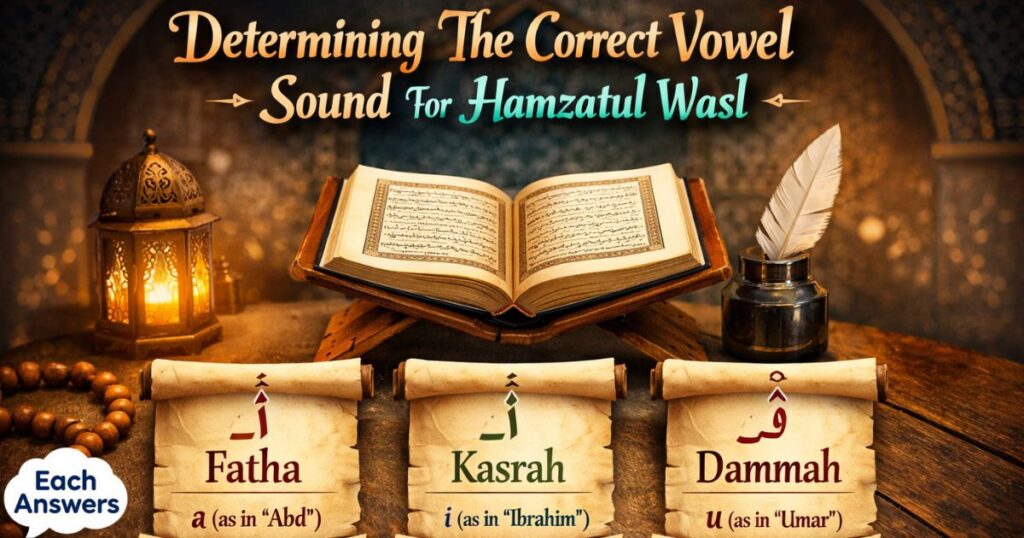
When you start recitation with hamzatul wasl, using the right vowel matters enormously. Say the wrong one and your pronunciation shifts noticeably. The rules here are straightforward once you know them.
Each word category follows its own vowel pattern. Definite articles, nouns and verbs each have distinct rules. Learning them separately makes the whole system click into place quickly.
Getting the vowel right elevates your recitation from correct to truly polished. It’s a small detail with a big impact. Native Arabic speakers notice it immediately.
For The Definite Article (ٱلـ)
The definite article always takes fatha, the short “a” sound. So ٱلْقُرْآن always starts as “al-Quran.” Simple, consistent and easy to remember without any exceptions.
This fatha never changes regardless of what follows. Whether the next letter is a sun letter or moon letter, the hamzatul wasl vowel stays fatha. Only the “l” sound changes with sun letters.
Practice this with familiar words from Surah Al-Fatiha. ٱلْحَمْدُ starts as “al-hamdu.” ٱلرَّحْمٰنُ starts as “ar-rahman.” The fatha on hamzatul wasl remains constant throughout.
Hamzatul Wasl For Nouns
Most nouns with hamzatul wasl take kasra, the short “i” sound. So ٱسْم becomes “ism” and ٱبْن becomes “ibn.” This kasra applies to the majority of nouns consistently.
The seven irregular nouns all follow this kasra rule. Once you memorize that pattern, you don’t need to think twice. Your tongue naturally reaches for the “i” sound every time.
A few exceptions exist but they’re rare. For most learners at beginner and intermediate levels, defaulting to kasra for nouns works reliably. Refine the exceptions as your knowledge deepens.
Hamzatul Wasl For Verbs
Verb vowels follow a unique rule based on the third letter of the past tense form. This might sound complex but it’s actually quite logical once you see it in action.
| Third Letter Vowel | Hamzatul Wasl Vowel | Example |
| Dammah (u) | Dammah (u) | ٱدْخُلُوا → “udhkhulu” |
| Kasra (i) | Kasra (i) | ٱسْتَغْفِرُوا → “istaghfiru” |
| Fatha (a) | Kasra (i) | Default rule applies |
Always check the third letter first. That single check tells you exactly which vowel to use. With practice, this becomes automatic and effortless during recitation.
The Difference Between Hamzatul Wasl Vs Hamzatul Qat’
Learn more:Fajr Prayer: Time and Importance in Islam
These two types of hamza confuse learners constantly. They look similar but behave completely differently. Mixing them up leads to genuine mispronunciation that changes how words sound.
Hamzatul wasl connects and disappears in flowing speech. Hamzatul qat’ stands firm and is always pronounced. One bridges words together and the other cuts through them with a clear glottal stop.
| Feature | Hamzatul Wasl | Hamzatul Qat’ |
| Position | Beginning only | Anywhere in word |
| Pronunciation | Context-dependent | Always pronounced |
| Symbol | ٱ (small saad) | أ إ ؤ ئ |
| Vowel marked | No | Yes |
What Is Hamzatul Qat’?
Hamzatul qat’ literally means “the cutting hamza.” It cuts through speech with a distinct glottal stop. Unlike hamzatul wasl, it never disappears regardless of what surrounds it.
You’ll find hamzatul qat’ at the beginning, middle or end of words. It carries its own vowel marking above or below it. That visible hamza symbol is your clearest identification clue.
Words like أَكَلَ (he ate) and أَنْتَ (you) carry hamzatul qat’. Say them mid-sentence and the hamza remains fully pronounced. It never softens, never drops and never blends away.
Quick Test To Identify Hamzatul Wasl
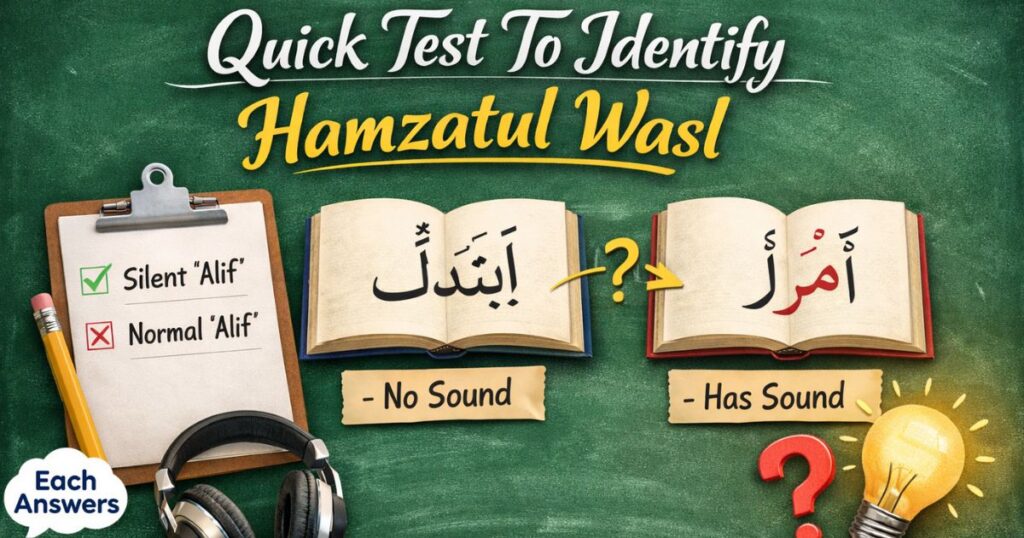
Here’s a foolproof test. Add the conjunction وَ (and) before any word starting with hamza. Then say it aloud naturally. What happens to the hamza tells you everything.
If the hamza disappears during pronunciation, it’s hamzatul wasl. If it stays clearly audible, it’s hamzatul qat’. This simple test works every single time without fail.
Try it yourself. وَٱلْكِتَاب becomes “wal-kitab” hamza gone, so it’s hamzatul wasl. وَأَكَلَ stays “wa-akala” hamza present, so it’s hamzatul qat’. Clean, fast and reliable.
Special Tajweed Cases: Hamzatul Wasl With Tanween And Other Letters
Hamzatul wasl interacts with other Tajweed rules in specific situations. These interactions require extra attention. Missing them creates subtle errors that affect the overall quality of recitation.
Three main cases deserve focused study: tanween preceding hamzatul wasl, connecting particles before it and words ending in sukoon. Each case has its own clear ruling that experienced reciters apply instinctively.
Understanding these special cases separates intermediate reciters from advanced ones. They’re not overwhelmingly complex. But they do require deliberate practice before they become second nature.
When Preceded By Tanween?
When tanween comes before hamzatul wasl, the nun of tanween takes kasra. This prevents two consecutive silent consonants from clashing awkwardly. The result is smooth and natural sounding recitation.
For example, رَجُلٌ ٱسْمُهُ becomes “rajulinis-muhu” in pronunciation. The tanween shifts to an “in” sound with kasra. The hamzatul wasl then drops and the connection flows uninterrupted.
Practice this specific pattern deliberately. It appears frequently in Quranic text. Once your ear recognizes it, your tongue follows automatically without conscious thought during recitation.
When Preceded By Connecting Particles?
Particles like وَ (and) and فَ (so) precede hamzatul wasl regularly throughout the Quran. In these cases, the hamza drops completely. The particle’s vowel connects directly to the following consonant.
وَٱسْتَعِينُوا becomes “wastai’nu” in pronunciation. فَٱدْخُلِي becomes “fadkhuli.” The hamzatul wasl vanishes and both words merge into one fluid sound unit.
This happens so naturally in fluent recitation that many learners don’t even notice it. But understanding the rule consciously helps you apply it correctly rather than accidentally.
When Preceded By Words Ending In Sukoon?
When مِنْ (from) precedes hamzatul wasl, the silent noon takes fatha automatically. This adjustment prevents two sukoon letters from colliding in pronunciation. The Quranic script reflects this ruling directly.
Words ending in long vowels follow a different ruling called “prevention of two sakins meeting.” Both the hamzatul wasl and the long vowel drop together. This keeps the phonetic flow clean and correct.
These cases are advanced but important. They surface regularly during longer recitation sessions. Knowing them prevents hesitation and keeps your recitation confident and uninterrupted.
Practical Learning Strategies For Mastering Hamzatul Wasl
Mastering hamzatul wasl doesn’t happen overnight. It takes consistent, structured practice. But with the right strategies, progress comes faster than most learners expect.
The key is layering your learning. Start with recognition then move to pronunciation then build speed. Each layer reinforces the previous one and your confidence grows with every session.
These strategies work for complete beginners and intermediate learners alike. Pick the ones that suit your learning style. Combine several together for maximum impact and faster retention.
Start With Pattern Recognition
Begin with the definite article ٱلـ since it’s everywhere. Train your eyes to spot that small saad symbol instantly. Pattern recognition is the foundation everything else builds upon.
Next memorize the seven irregular nouns by heart. Write them out daily. Say them aloud repeatedly. Once they’re locked in memory, you’ll recognize them instantly during recitation without slowing down.
Create flashcards with both forms of each word. One side showing the written form and the other showing pronunciation. Daily review sessions of even ten minutes build surprisingly strong recognition skills.
Practice With Marked Mushafs
A color-coded Tajweed Mushaf is genuinely worth owning. It highlights hamzatul wasl visually making it impossible to overlook during reading. Your eyes and brain start connecting the symbol to the rule automatically.
Read the same verse twice deliberately. First starting from the hamzatul wasl word, pronouncing it clearly. Then read it mid-sentence dropping the hamza. This contrast trains your ear to hear the difference.
Many learners underestimate visual reinforcement. But seeing the same rule highlighted consistently across hundreds of verses builds deep intuitive understanding that purely audio learning can’t fully replicate.
Listen To Expert Reciters
Listening is half the battle in Tajweed. Sheikh Abdul Basit, Sheikh Mishary Rashid and Sheikh Muhammad Siddiq Al-Minshawi demonstrate hamzatul wasl with breathtaking natural precision throughout their recitations.
Focus specifically on verse beginnings and continuous passages. Notice how smoothly hamzatul wasl appears and disappears. Your ear is training itself even when your conscious mind isn’t analyzing every detail.
Use platforms that offer verse-by-verse playback with text highlighting. Follow along visually while listening. This dual-channel approach accelerates learning and builds strong audio-visual connections simultaneously.
Work With A Qualified Teacher
Self-study builds knowledge but a qualified teacher catches errors you genuinely can’t hear yourself making. Subtle vowel mistakes on hamzatul wasl often go unnoticed without expert ears guiding you.
Look for teachers certified by Al-Azhar or other reputable Islamic institutions. Many now teach online offering flexible scheduling for students worldwide. One-on-one sessions deliver personalized feedback that group classes simply can’t match.
Even monthly check-in sessions with a teacher make a measurable difference. They identify patterns in your mistakes and give targeted exercises. That targeted correction saves months of practicing errors unknowingly.
Use Minimal Pairs For Practice
Minimal pairs are words differing only by one sound. They sharpen your ability to hear and produce subtle distinctions. For hamzatul wasl, this kind of focused practice is remarkably effective.
Compare ٱقْرَأْ (iqra, read with hamzatul wasl) against أَقْرَأُ (aqra’u, I read with hamzatul qat’). The difference is small but meaningful. Mispronouncing one changes the word’s meaning entirely.
Practice these pairs slowly at first. Then gradually increase speed. Record yourself and compare your pronunciation against expert reciters. The gap between the two recordings narrows faster than you’d expect.
Regular Reading Aloud
Silent reading doesn’t build recitation skills. You must read aloud daily. Your mouth, tongue and breath need consistent physical practice to internalize hamzatul wasl naturally and effortlessly.
Start with short familiar surahs from daily prayers. Al-Fatiha alone contains multiple instances of hamzatul wasl. Mining familiar text for practice opportunities makes learning feel less like study and more like worship.
Gradually expand to longer passages. Track your progress weekly. Most learners notice significant improvement within thirty days of consistent daily reading aloud even if sessions are only fifteen minutes long.
Common Mistakes And How To Avoid Them
Every learner makes mistakes with hamzatul wasl. That’s completely normal. What matters is identifying your specific errors early and correcting them before they solidify into stubborn habits.
Four mistakes appear most frequently among learners at all levels. Knowing them in advance puts you ahead of the curve. Awareness is genuinely half the battle when it comes to Tajweed precision.
Mistake 1: Pronouncing Hamzatul Wasl In The Middle Of Speech
This is the most common error. Learners pronounce hamzatul wasl mid-sentence as if it were hamzatul qat’. The result sounds choppy and technically incorrect to trained ears.
Before reading any verse, mentally scan for all hamzatul wasl instances. Mark them in your practice Mushaf if needed. Then during continuous reading, consciously let the preceding vowel flow straight through.
It feels unnatural at first. Stick with it. After enough repetitions your tongue drops the hamza automatically without conscious effort and your recitation gains noticeable smoothness.
Mistake 2: Dropping Hamzatul Qat’ By Mistake
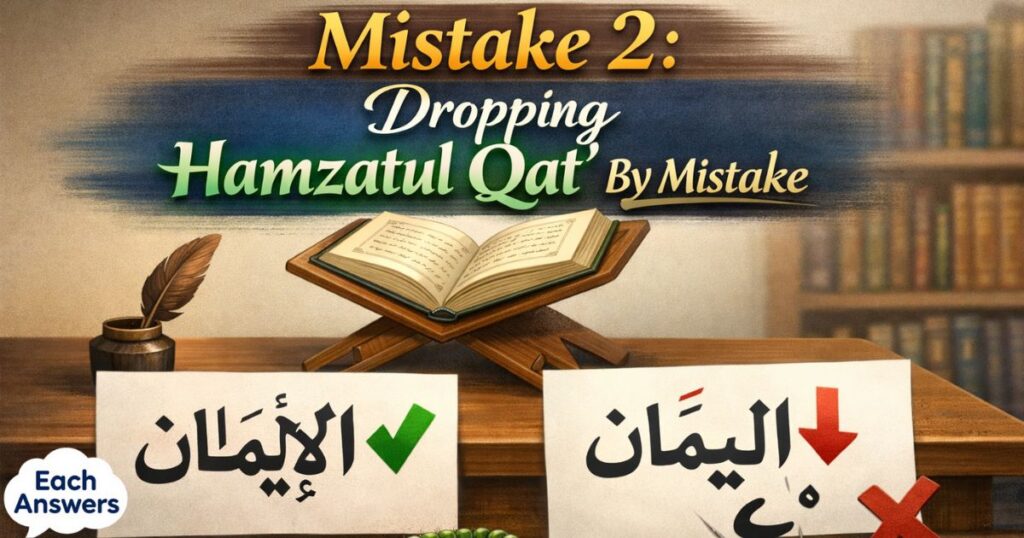
The reverse error trips up learners who’ve overcorrected. They see any alif at a word’s beginning and assume it must be hamzatul wasl. So they drop it when it absolutely should be pronounced.
The fix is visual. A hamza symbol above or below the alif means hamzatul qat’. A vowel marking on the alif means hamzatul qat’. Only the small saad symbol marks hamzatul wasl.
Train your eyes to check the symbol before reading. This split-second visual check prevents the error entirely. With practice the identification becomes instantaneous and completely effortless.
Mistake 3: Using The Wrong Vowel Sound
Starting recitation with the wrong vowel on hamzatul wasl is a subtle but real error. Saying “ul-kitab” instead of “al-kitab” for the definite article immediately signals incorrect Tajweed to knowledgeable listeners.
Memorize the three vowel rules cold. Fatha for definite articles. Kasra for most nouns. Third-letter rule for verbs. Drill these rules separately until they’re completely automatic before combining them in full recitation.
When uncertain about a verb’s vowel, check the third letter of its past tense form first. That single check resolves the question every time without needing to guess or hesitate.
Mistake 4: Not Applying The Tanween Rule
Forgetting to shift tanween to kasra before hamzatul wasl creates an awkward pronunciation clash. Two consecutive silent sounds collide and the recitation stumbles noticeably at that junction.
Train yourself to recognize the tanween plus hamzatul wasl combination on sight. Whenever you see tanween followed by ٱ, automatically convert that tanween to an “in” sound with kasra before proceeding.
Practice this pattern in isolation first using simple word pairs. Then practice it within full verses. Repetition builds the automatic response your recitation needs to handle this junction smoothly every time.
FAQ’S
What exactly is Hamzatul Wasl?
Hamzatul Wasl is a connecting hamza in Arabic. It appears at the beginning of certain words and drops silently during continuous Quran recitation.
How do I know when to pronounce Hamzatul Wasl?
Pronounce Hamzatul Wasl only when starting a new utterance or after a pause. Drop it completely when the previous word ends in a vowel.
Where does Hamzatul Wasl appear most often?
Hamzatul Wasl appears most frequently in the definite article ٱلـ. You’ll also find it in command verbs and seven specific irregular Arabic nouns.
How is Hamzatul Wasl different from Hamzatul Qat?
Hamzatul Wasl drops during connected speech while Hamzatul Qat is always pronounced. Their written symbols are different too making visual identification straightforward and reliable.
Can beginners learn Hamzatul Wasl quickly?
Absolutely. Start by mastering the definite article ٱلـ first. Then memorize the seven irregular nouns. Consistent daily practice makes Hamzatul Wasl feel completely natural fast.
Conclusion
Hamzatul Wasl Explained Step-by-Step: The Connecting Hamza in Quran Recitation covers everything you need. Hamzatul wasl isn’t just a rule. It’s the secret behind smooth, beautiful recitation. Once you understand hamzatul wasl, your Quran reading transforms completely. Short sentences, clear rules and daily practice make it achievable for everyone.
Don’t underestimate hamzatul wasl. It connects words, smooths speech and honors the Quran’s linguistic beauty. Every Muslim deserves to recite with confidence and precision. Master hamzatul wasl step by step. Stay consistent, practice daily and watch your recitation reach a whole new level of excellence.