
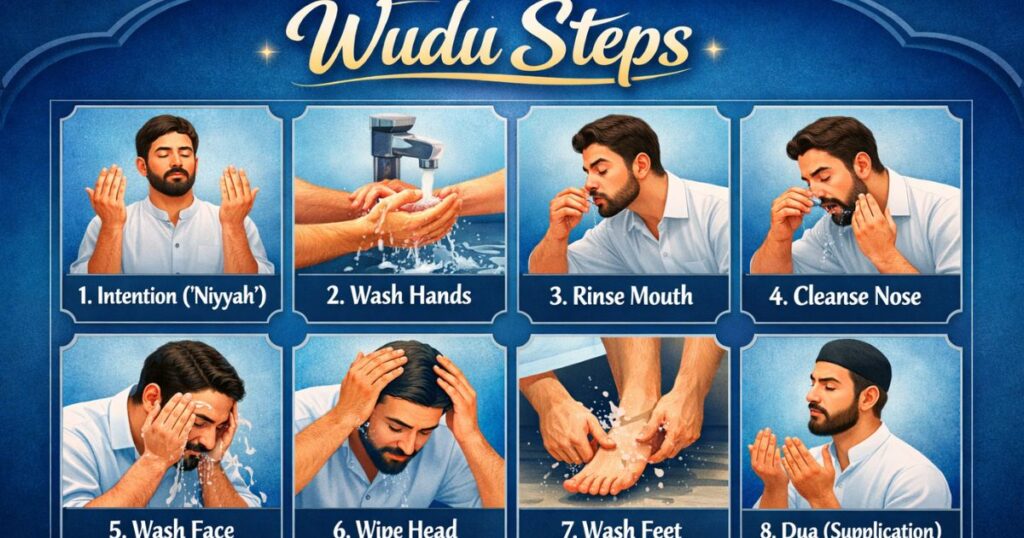
Wudu steps are the secret behind every powerful prayer. Five times a day, millions of Muslims perform these sacred steps and for good reason. It’s not just washing. It’s a spiritual transformation that happens right at your sink. Each wudu step strips away the noise of daily life and prepares your heart for something greater.
Getting your wudu steps right matters more than most people realize. One missed step means starting over completely. But don’t let that intimidate you. The wudu steps are beautifully simple once you know them. This guide walks you through every single step clearly, confidently, and without confusion. Pure intention. Clean heart. Perfect prayer.
What Is Wudu?
Wudu is the Islamic ritual of purification performed before prayer. The Arabic word means beauty and radiance. It’s a physical and spiritual cleansing that prepares Muslims for worship. Every believing Muslim performs it daily.
The Quran directly commands wudu in Surah Al-Ma’idah (5:6). Allah instructs believers to wash their faces, arms, wipe their heads and wash their feet. This divine command makes wudu an act of pure obedience.
Wudu isn’t just hygiene. It’s a soul-level transition from worldly distraction to divine connection. Each wash symbolizes washing away minor sins. It resets your mind and purifies your heart before standing before Allah.
Conditions Of A Valid Wudu
Every wudu must meet specific conditions to be accepted. Without these conditions, the ritual is invalid. Think of them as the rules that separate a spiritual act from a simple morning wash.
These conditions come from Quranic injunctions and prophetic teachings. Scholars across all major schools of Islamic jurisprudence agree on them. They ensure wudu is performed correctly and sincerely every single time.
Meeting these conditions isn’t complicated. Most Muslims fulfill them naturally without thinking. Understanding them deeply helps you perform wudu with greater awareness, confidence and spiritual intentionality every day.
Intention (Niyyah)
Niyyah is the silent intention formed in your heart before beginning wudu. It’s what separates worship from habit. Without it, you’re simply washing your face nothing more and nothing less.
You don’t speak the intention aloud. It lives in your heart. The moment you consciously decide to purify yourself for Allah’s sake, the spiritual act begins. That internal commitment is everything.
The Prophet Muhammad (ﷺ) said “actions are judged by intentions.” This hadith is the backbone of Niyyah’s importance. Your wudu carries exactly as much spiritual weight as the sincerity behind your intention.
Pure Water (Al-Maa’ Al-Tahur)
Only naturally pure water is valid for wudu. Rainwater, river water, tap water and well water all qualify. Water contaminated with impurities or heavily altered by substances like juice or soap does not count.
The water must retain its natural color, taste and smell. Even a small contamination can invalidate it. Always check your water source if you’re in an unusual location or traveling somewhere unfamiliar.
This condition exists to honor the purity of the ritual itself. Pure water for a pure act it’s that straightforward. Islam places immense value on cleanliness at every level of daily life.
Removal Of Barriers
Water must physically touch your skin to count. Anything blocking that contact invalidates your wudu. Waterproof nail polish, thick paint, wax or glue are common culprits that create invisible barriers.
Before starting wudu, remove every impermeable substance. This applies to heavy waterproof makeup too. If water can’t penetrate it, your wudu won’t be valid no matter how carefully you wash.
Permeable substances like henna or regular moisturizer are fine. They absorb into skin and don’t block water flow. When in doubt, remove it. It’s always better to be safe than to repeat your prayer.
Flow Of Water
Water must actually flow over the limbs being washed. Simply pressing a wet hand against your arm isn’t enough. The water needs to move and cover the entire required surface area properly.
This condition applies specifically to the face, arms and feet. These are washed not just dampened. The head is different it requires wiping not flowing water so the rules differ slightly there.
Think of it like rinsing fruit under a tap versus just touching it with a damp cloth. One actually cleans and the other barely touches the surface. Wudu follows the same logic precisely.
Other Foundational Conditions
A person performing wudu must be Muslim. They also need to be of sound mind and have reached the age of discernment. These aren’t arbitrary rules they’re prerequisites for any valid act of Islamic worship.
Sound mind ensures the person understands what they’re doing. A child who understands the ritual can perform valid wudu. These conditions apply universally across all schools of Islamic jurisprudence without exception.
These foundational conditions are often overlooked because they seem obvious. But understanding them matters. They remind every Muslim that wudu is a conscious, intentional act of worship not a mechanical routine performed on autopilot.
How To Perform The Wudu Purification Ritual In Islam?

Performing wudu follows a precise sequence of steps. Each step is either obligatory (Fard) or recommended (Sunnah). Knowing the difference helps you understand what’s essential and what perfects the act further.
The Prophet Muhammad (ﷺ) demonstrated every detail of wudu. His teachings expanded the Quranic foundation into a complete and beautiful ritual. Following his example brings immense spiritual reward beyond just ritual validity.
Here’s what you need to know before starting. Have clean water ready. Form your intention. Say Bismillah. Then follow each step deliberately and mindfully. Rushing through wudu defeats its entire spiritual purpose completely.
Niyyah (Intention) & Saying “Bismillah”
Form your intention silently in your heart first. You don’t say it aloud. Simply decide “I am performing wudu for the sake of Allah.” That quiet commitment activates the spiritual dimension of everything that follows.
Then say “Bismillah” In the name of Allah. This verbal declaration is a highly recommended Sunnah. It sanctifies the beginning of your wudu and invites divine blessing into every single step you take.
Together Niyyah and Bismillah set the tone for the entire ritual. They shift your mindset from routine to worship. Never skip them. They cost you nothing and add immeasurable spiritual value to your purification.
Washing The Hands (x3)
Start by washing both hands thoroughly up to and including the wrists. Begin with the right hand then the left. This right-before-left sequence follows the beloved Sunnah of Prophet Muhammad (ﷺ) directly.
Interlace your fingers as you wash. Water must reach the skin between every finger. Three full washes ensure thorough cleanliness. This step also prepares your hands for scooping and pouring water in subsequent steps.
Washing hands first is a Sunnah not a Fard obligation. But skipping it means missing out on extra reward and the complete prophetic method. Always aim for the full version when you possibly can.
Rinsing The Mouth (x3)
Cup water in your right hand and bring it to your mouth. Swirl it around vigorously then spit it out completely. Do this three full times to properly cleanse your mouth before prayer.
Using a miswak during this step is a beautiful Sunnah. The Prophet (ﷺ) loved the miswak and praised it often. It cleans the teeth and freshens the mouth in a spiritually meaningful way.
Rinsing the mouth symbolizes purifying your speech. Every harsh word every lie every backbiting comment gets spiritually washed away. It’s a powerful reminder to guard your tongue before standing before Allah.
Sniffing And Expelling Water From The Nose (x3)
Learn more:The Powerful of Ameen Meaning in Arabic
Use your right hand to sniff a small amount of water gently into your nostrils. Then use your left hand to blow it back out. Repeat this three times for a complete and valid cleansing.
Don’t inhale too forcefully. A gentle sniff reaches the lower nostril area which is sufficient. This step cleanses the nasal passage and carries symbolic meaning breathing in purity before approaching Allah in prayer.
This is a Sunnah action so it doesn’t invalidate wudu if missed. But performing it fully follows the prophetic method perfectly. Every Sunnah step adds reward and brings you closer to the ideal form of worship.
Washing The Face (x3)
This is the first obligatory (Fard) step of wudu. Use both hands to wash your entire face. Coverage must run from the natural hairline down to the chin and from earlobe to earlobe fully.
Wash three times for the complete Sunnah method. Miss any part of your face and your wudu is invalid. Pay extra attention to the corners of your eyes and the sides of your nose.
For those with beards, run wet fingers through the beard. If it’s thin, water should reach the skin beneath. If it’s thick, wetting the external hair is sufficient. Don’t overlook this common and important detail.
Washing The Arms (x3)
Wash from the fingertips all the way up to and including the elbow. Start with the right arm then move to the left. The elbow must be fully covered this is where many people make mistakes.
Three washes per arm follow the complete Sunnah method. Make sure water flows over every inch. Roll up long sleeves beforehand so nothing blocks the water from reaching your full arm and elbow area.
This is the second obligatory step of wudu. No shortcuts here. Your prayer depends on washing both arms correctly and completely. Take an extra second to ensure the elbow is fully wet every single time.
Wiping The Head (Masah) (x1)
Wet both hands and wipe from the front hairline to the back of the neck in one smooth motion. Then bring your hands forward again. This entire action counts as one single wiping of the head.
This is the third Fard step of wudu. Wiping a portion of the head is the minimum requirement. But wiping the full head in the described prophetic manner is the Sunnah and far more rewarding spiritually.
Don’t use fresh water for this step. The moisture already on your hands from previous steps is sufficient. Masah is wiping not washing. That distinction matters greatly in Islamic jurisprudence and must never be confused.
Wiping The Ears (x1)
Use the same wet hands from the head wiping step. Insert your index fingers into the inner crevices of both ears simultaneously. Use your thumbs to clean the back of the ears at the same time.
No new water is needed here either. This step connects directly to the head wiping and uses the same moisture intentionally. It’s a Sunnah action according to the majority of Islamic scholars worldwide.
Wiping the ears is quick but meaningful. Symbolically it represents purifying what you hear. Cleaning both the inner and outer ear ensures thorough coverage and follows the complete prophetic method of performing wudu properly.
Washing The Feet (x3)
This is the fourth and final obligatory step. Wash both feet up to and including the ankles. Start with the right foot then the left. Three washes complete the full Sunnah method beautifully.
Use your fingers to clean between every toe. The pinky finger of the left hand is specifically recommended for this. Pay close attention to heels and ankles dry spots there invalidate this critical step entirely.
Don’t rush the feet. Many people treat this as an afterthought but it’s Fard. Water must flow and cover everything up to the ankle completely. A properly washed foot seals a complete and valid wudu.
Dua After Wudu
Seal your wudu with this powerful supplication taught by the Prophet (ﷺ):
أَشْهَدُ أَنْ لَا إِلَٰهَ إِلَّا اللهُ وَحْدَهُ لَا شَرِيكَ لَهُ، وَأَشْهَدُ أَنَّ مُحَمَّدًا عَبْدُهُ وَرَسُولُهُ
Transliteration: Ash-hadu an la ilaha illallah, wahdahu la sharika lah, wa ash-hadu anna Muhammadan ‘abduhu wa rasuluh.
Translation: I bear witness that there is no deity worthy of worship except Allah alone with no partner and I bear witness that Muhammad is His servant and His Messenger.
Then add this beautiful plea:
اللَّهُمَّ اجْعَلْنِي مِنَ التَّوَّابِينَ، وَاجْعَلْنِي مِنَ الْمُتَطَهِّرِينَ
Transliteration: Allahummaj’alni minat-tawwabina waj’alni minal-mutatahhirin.
Translation: O Allah make me among those who repent and make me among those who purify themselves.
The Prophet (ﷺ) promised that whoever recites this dua after wudu will have all eight gates of Paradise opened for them. That’s an extraordinary reward for just a few sincere seconds of remembrance after purification.
Reciting this dua transforms the end of wudu into a moment of deep faith. It links physical cleansing directly to the Shahada Islam’s core testimony. Never skip it. It costs nothing and earns everything.
The Difference Between Men And Women In Wudu

Here’s the simple truth the wudu steps are identical for men and women. The Quran addresses all believers equally. The Prophet (ﷺ) never prescribed a separate ritual for women. The Fard and Sunnah steps remain exactly the same.
However practical considerations differ. Modern life introduces female-specific situations that need clear rulings. Nail polish, hijab and jewellery all raise valid questions about wudu validity. These aren’t differences in ritual they’re applications of core principles to real life.
Understanding these nuances helps women perform wudu correctly with confidence. Knowledge removes uncertainty. Every Muslim woman deserves to know exactly how to fulfill this obligation without unnecessary doubt or confusion holding her back.
Nail Polish And Makeup
Most commercial nail polishes are waterproof and form an impermeable layer. Water can’t penetrate them so they invalidate wudu completely. Women must remove nail polish before performing a valid wudu for prayer.
Breathable or “halal” nail polishes claim water permeability. However scholars debate their actual validity. Until there’s clear scholarly consensus the safest approach is to remove all nail polish before wudu without exception.
Heavy waterproof foundation and thick cosmetic layers create the same barrier problem. Lightweight permeable products like regular moisturizer are generally fine. When in doubt remove it. Valid wudu is more important than any cosmetic.
Wiping Over The Hijab (Headscarf)
The primary and most authentic method is wiping directly onto the hair. This is the explicit Sunnah of the Prophet (ﷺ). Whenever possible every woman should wipe her actual hair during wudu without exception.
Some scholars permit wiping over the hijab in situations where removing it is genuinely difficult like in a very public space with no privacy. This concession is based on the Prophet’s practice of wiping over his turban.
This ruling brings welcomed ease for practicing Muslim women. However it remains a concession not the default. Wiping directly on the hair is always preferred and should be the standard practice whenever privacy is available.
Jewellery
Rings, bangles and tight bracelets can block water from reaching the skin beneath. Women must move these items during wudu to ensure water flows underneath and covers every inch of required skin fully.
Loose jewellery that allows water to flow underneath naturally doesn’t need adjusting. The key principle is simply this water must touch skin. If jewellery prevents that it must be moved or temporarily removed.
This applies to men too but it’s more commonly relevant for women. Check your rings especially. A tight ring that traps a dry patch of skin beneath it can quietly invalidate an otherwise perfectly performed wudu.
How To Do Wudu In Ihram For Ladies?
Performing wudu during Hajj or Umrah follows the exact same steps as always. The ritual itself doesn’t change. However the sacred state of Ihram introduces specific restrictions that affect how women approach their purification practically.
These restrictions aren’t meant to complicate things. They exist to protect the sanctity of Ihram. Understanding them ahead of time prevents anxiety and confusion during one of the most spiritually significant journeys of a Muslim woman’s life.
Prepare before entering Ihram. Know the rules. Pack unscented products. Plan for privacy during wudu. A little preparation transforms potential stress into smooth confident worship throughout the entire blessed journey ahead.
1- Use Of Scented Products
Ihram prohibits all perfumes and scented products without exception. This includes scented soaps, shampoos and lotions. During wudu women must use only unscented soap and completely fragrance-free water-based products for washing.
Pack unscented alternatives before entering Ihram. Many brands now offer fragrance-free soap specifically designed for Hajj and Umrah travelers. Preparation matters scrambling to find unscented products during the pilgrimage creates unnecessary and avoidable stress.
Even accidentally using a scented product can require expiation. It’s not worth the risk. Simple unscented options fulfill the cleansing requirement of wudu while fully respecting the sanctity of the Ihram state throughout.
2- Hair Loss
Accidental hair loss during wudu doesn’t violate Ihram. Scholars are clear on this. A few loose hairs falling out naturally while wiping your head during wudu is completely unintentional and carries no penalty whatsoever.
The Ihram prohibition targets deliberate cutting or plucking of hair. Intent is everything here. Washing and wiping your head gently and carefully during wudu is a necessary act accidental loss is simply unavoidable.
Don’t let fear of hair loss cause you to skip or rush the head wiping step. Perform it normally and carefully. Allah does not burden a soul beyond what it can bear this ruling reflects that beautiful mercy perfectly.
3- Covering The Face
Women in Ihram cannot wear a face-covering niqab that physically touches the face. Yet wudu requires washing the entire face completely. This creates a situation that requires a little thoughtful planning and modest awareness.
Find a private space for wudu whenever possible. A bathroom stall, a private room or a screened area works perfectly. Washing your face away from non-mahram men while maintaining modesty fulfills both the Ihram rule and wudu obligation simultaneously.
This isn’t as difficult as it sounds. Pilgrimage facilities at Makkah and Madinah provide ample private spaces for women. A little awareness and planning ensures wudu remains valid and modesty stays fully intact throughout Ihram.
Why Is Wudu Important?
Wudu is the non-negotiable key to Salah. Without it your prayer simply isn’t accepted. The Prophet (ﷺ) said clearly “Allah does not accept the prayer of any one of you when he is in a state of impurity until he performs wudu.” That settles it.
Beyond prayer validity wudu physically washes away minor sins. Every limb washed carries sins away with the dripping water. The Prophet (ﷺ) described this beautifully in Sahih Muslim a believer emerges from wudu completely cleansed of minor transgressions.
On the Day of Resurrection believers will shine with radiant light on the parts washed during wudu. The Prophet (ﷺ) called his followers “Al-Ghurr Al-Muhajjalun” the radiant ones. That eternal radiance begins right here at your sink every single day.
Can I Read The Quran Without Wudu?
The answer depends entirely on how you’re engaging with the Quran. Touching a physical Mushaf requires wudu according to the vast majority of scholars. Reciting from memory does not. Reading on a phone falls somewhere nuanced in between.
Understanding these distinctions matters practically. Life is busy. You won’t always have wudu. Knowing what’s permitted without it lets you stay connected to the Quran even during ordinary moments throughout your day without spiritual anxiety.
The core principle is reverence. The Quran deserves your highest respect regardless of ruling. Having wudu when reading in any format is always the more honorable choice even when it isn’t strictly required by law.
Key Takeaways: Wudu And Interacting With The Quran

Here’s a quick reference table summarizing the rulings clearly:
| Method of Interaction | Wudu Required? |
| Touching a physical Mushaf | Yes majority scholarly opinion |
| Reciting from memory | No permissible without wudu |
| Reading on phone or tablet | No but recommended for reverence |
| Listening to recitation | No no wudu required |
| Teaching Quran to others | Recommended but not obligatory |
These rulings come from centuries of careful Islamic scholarship. They balance reverence for the Quran with practical accessibility for every Muslim in every situation and circumstance of daily life.
1. Touching The Physical Quran (Mushaf)
The majority of scholars across all four major schools agree you need wudu to touch a physical Mushaf. This ruling draws from Surah Al-Waqi’ah (56:77-79) and a letter the Prophet (ﷺ) sent to Yemen.
That letter included the instruction “No one should touch the Quran except one who is pure.” Scholars interpret this as requiring ritual purity. The physical Mushaf carries a sacred status that demands your utmost respect and preparation.
This isn’t meant to restrict access to the Quran. It’s meant to elevate your interaction with it. Every time you make wudu before touching the Mushaf you honor the immense sanctity of Allah’s preserved and eternal word.
2. Reciting The Quran Without Wudu (From Memory)
Reciting the Quran from memory without wudu is completely permissible. Scholars are in consensus on this. Minor ritual impurity doesn’t prevent you from engaging with Allah’s words through memorized recitation at any time.
This ruling is a mercy. It keeps the Quran alive on your tongue throughout the day. Driving, cooking, walking you can recite freely without wudu. The prohibition on touching the Mushaf doesn’t extend to your memorized verses.
One important exception exists. A person in a state of major ritual impurity (Janabah) must perform a full Ghusl before reciting the Quran. Minor impurity and major impurity carry entirely different rulings understanding this distinction is essential.
3. Reading The Quran Without Wudu On Phone / Digital Devices
Reading the Quran on your phone without wudu is permissible according to the dominant scholarly position. A phone isn’t a Mushaf. The screen displays pixels not sacred ink permanently inscribed on blessed pages.
The device has dozens of other functions. Its identity isn’t exclusively that of a Quran. Therefore the specific ruling protecting the physical Mushaf doesn’t extend to your smartphone or tablet screen. Scholars are broadly agreed on this.
However reverence always matters. Reading the Quran on your phone with wudu is a more honorable and spiritually enriching approach. Permissible doesn’t mean you can’t do better. Always aim for the highest level of respect for Allah’s words.
Why Is Intention (Niyyah) Required Before Wudu?
Niyyah is the soul behind every Islamic action. Without it wudu is just water on skin. The Prophet (ﷺ) established this principle clearly “actions are but by intentions.” This single hadith underpins everything in Islamic worship including purification.
Niyyah is what separates a believer’s life from mere routine. It transforms ordinary moments into extraordinary worship. Forming the intention before wudu tells Allah “I’m doing this for You.” That silent declaration changes everything about the act.
Without Niyyah even the most perfectly executed wudu carries no spiritual reward. The water flows but the blessing doesn’t. Intention is invisible yet it’s the most powerful part of the entire purification process every single time.
Distinguishing Worship From Habit
You might splash water on your face a dozen times daily. Only one of those times the one preceded by Niyyah counts as wudu. Intention is the invisible line between worship and habit and between reward and routine.
Think about it this way. Two people perform identical washing motions at the same sink. One has Niyyah. One doesn’t. Spiritually those two acts are completely different. Same water same hands entirely different outcomes before Allah.
This is why scholars emphasize Niyyah so strongly. It ensures Muslims remain conscious during worship. Every act of wudu becomes a deliberate choice a small but meaningful declaration of faith repeated multiple times throughout every single day.
Aligning The Inner And Outer State
Wudu cleans your body. Niyyah aligns your heart. Together they create a complete act of worship that engages both your physical presence and your spiritual consciousness simultaneously. One without the other is incomplete by definition.
Forming Niyyah is an act of mindfulness before mindfulness was trendy. It pulls your attention away from distractions and focuses it entirely on what matters preparing yourself sincerely to stand before your Creator in prayer.
This alignment is the whole point. Islam doesn’t separate the physical from the spiritual. Every drop of water in wudu is meant to carry spiritual weight. Niyyah is what loads that weight onto each and every blessed drop.
Can I Perform Wudu Without Running Water?
Absolutely yes. Running water is convenient but not required. Wudu is valid using any stored pure water a jug, bottle, bucket or basin all work perfectly well for performing a complete and spiritually valid wudu.
The Prophet (ﷺ) himself performed wudu with remarkably little water. Scholars record he used as little as one mudd roughly the amount held in two cupped hands. Wasting water during wudu actually goes against the prophetic example directly.
Pour water over each limb and spread it with your hand to ensure full coverage. This method is not a compromise it’s actually closer to the prophetic Sunnah than leaving a tap running carelessly throughout your entire wudu.
The Alternative: Tayammum (Dry Ablution)
When water is completely unavailable Islam provides a beautiful mercy Tayammum. This dry purification uses clean earth, dust, sand or stone and is fully accepted as a substitute for wudu when specific conditions are genuinely met.
Tayammum is permitted when:
- Water is completely unavailable such as in a desert
- Available water is needed for drinking and using it for wudu risks dangerous thirst
- You’re ill or injured and water would worsen your condition
- Accessing water poses a genuine threat to your life or safety
How to perform Tayammum:
- Make the intention (Niyyah)
- Say “Bismillah”
- Strike both hands lightly on clean earth or stone
- Blow off excess dust from your hands
- Wipe your entire face once with both hands
- Strike the earth again then wipe the right hand and wrist with the left and vice versa
Tayammum is a testament to Islam’s deep compassion and practicality. Allah never burdens His servants beyond their capacity. This concession ensures no Muslim ever misses prayer simply because water isn’t available in their current situation.
FAQ’S
What are the basic wudu steps every Muslim must know?
The wudu steps include washing hands, rinsing mouth, cleaning nose, washing face, arms, wiping head, ears and feet. Simple and beautiful.
How many wudu steps are actually obligatory?
Only four wudu steps are truly obligatory washing the face, arms, wiping the head and washing both feet completely.
Do the wudu steps differ for men and women?
Not at all. The wudu steps are identical for everyone. Practical considerations like nail polish differ but the core ritual stays exactly the same.
What breaks your wudu after completing all the steps?
Passing urine, stool or wind immediately breaks your wudu. You must repeat all wudu steps again before performing any valid prayer.
Can you skip any of the wudu steps if you’re in a hurry?
Never skip obligatory wudu steps. Missing even one Fard step invalidates your entire wudu. Take the time your prayer depends on it.
Conclusion
The Wudu Guide: Learn the Steps and Benefits has walked you through everything you need. Wudu steps aren’t complicated. They’re beautiful, meaningful and deeply rewarding. Every wudu step connects your body directly to your soul. Start practicing today.
Mastering wudu steps transforms your daily prayer completely. Each step carries spiritual weight you can actually feel. Don’t rush the wudu steps give every wash the attention it deserves. Perform them correctly and your heart will feel the difference. Clean hands. Pure heart. Perfect prayer. The wudu steps are your daily reset button. Use them well.