

One wrong sound. That’s all it takes to change the entire meaning of Allah’s words. Tajweed rules exist for exactly this reason. They’re your ultimate guide to reciting the Quran with precision, beauty, and confidence. Every breath, every tongue movement, every lip position tajweed rules govern it all.
Here’s the truth most beginners don’t realize. Tajweed rules aren’t just technical guidelines. They’re a sacred trust passed down from the Prophet ﷺ himself. The word “heart” becomes “dog” with one mispronounced letter. That’s not a small mistake that’s a meaning completely destroyed. So whether you’re a complete beginner or refining your recitation, mastering tajweed rules will genuinely transform how you connect with the Quran forever.
What Are Tajweed Rules?
Tajweed rules are systematic guidelines for reciting the Quran correctly. The word “tajweed” literally means “to improve.” These rules cover pronunciation, articulation, and intonation. Every letter must come from its exact point of origin.
Think of tajweed rules as a science and an art combined. They tell you how long to stretch a vowel, when to merge sounds, and when to separate them. Without tajweed rules, meaning can easily get distorted.
Scholars have identified 14 main categories of tajweed rules. Each category serves a unique purpose. Together they form a complete system that preserves the Quran exactly as Allah revealed it to Prophet Muhammad ﷺ.
The 14 Essential Types Of Tajweed Rules
There are 14 essential types of tajweed rules every reciter must learn. Each type handles a different aspect of pronunciation. From articulation points to prolongation, these rules cover every sound in the Quran.
Some rules feel simple at first. Others take months of dedicated practice. But don’t get overwhelmed. Learning them one by one makes the journey manageable and deeply rewarding for every student.
Here’s a quick overview of all 14 types before diving deeper into each one. Understanding the big picture first helps everything click faster. It’s like seeing the map before starting the journey.
Al-Isti’adhah And Al-Basmalah (Seeking Refuge And Beginning)
Al-Isti’adhah means reciting “A’udhu billahi min ash-shaytan ir-rajim” before starting recitation. It seeks Allah’s protection from Shaytan. Al-Basmalah means reciting “Bismillah ir-Rahman ir-Raheem.” Both prepare your heart and tongue for sacred recitation.
Al-Basmalah is recited before every Surah except Surah At-Tawbah. This is a firm ruling all reciters must follow. Scholars also identify six different ways to combine both phrases when beginning a new Surah.
Reciting Al-Isti’adhah once suffices for an entire session. However, repeating it at each Surah is recommended. These opening phrases aren’t just formalities they spiritually anchor your recitation from the very first word.
Makharij Al-Huroof (Articulation Points Of Letters)
Makharij Al-Huroof refers to the exact physical points where each Arabic letter originates. There are 17 distinct articulation points. They’re divided across five main regions of the mouth, throat, lips, and nasal cavity.
| Region | Arabic | Points |
| Empty Space (Mouth/Throat) | الجوف | 1 |
| Throat | الحلق | 3 |
| Tongue | اللسان | 10 |
| Lips | الشفتان | 2 |
| Nasal Cavity | الخيشوم | 1 |
Getting Makharij right is non-negotiable. Pronouncing ق (Qaaf) from the wrong place turns “he said” into “he measured.” Small positional errors create massive meaning changes. Practice each letter’s origin point slowly and deliberately every single day.
Sifaat Al-Huroof (Characteristics Of Letters)

Every Arabic letter carries unique characteristics that shape how it sounds. These are called Sifaat Al-Huroof. Some characteristics have opposites and some stand completely alone. Together they define each letter’s personality.
| Characteristic | Opposite | Effect |
| Hams (Whispering) | Jahr (Voicing) | Continuous breath |
| Shiddah (Strength) | Rakhawah (Softness) | Sound stoppage |
| Isti’laa (Elevation) | Istifaal (Lowering) | Tongue rises |
| Itbaaq (Closing) | Infitah (Opening) | Tongue presses palate |
| Idhlaq (Fluency) | Ismaat (Difficulty) | Easy flow |
Seven additional characteristics stand alone without opposites. These include Qalqalah, Safeer, Ghunnah, and others. Mastering Sifaat separates average reciters from truly skilled ones. Each characteristic adds texture and depth to your recitation.
Noon Saakinah And Tanween: Izhar (Clear Pronunciation)
Izhar means “to make clear.” When Noon Saakinah or Tanween appears before any of six specific throat letters, you pronounce the Noon sound clearly and distinctly. No merging. No hiding. Pure clarity.
The six Izhar letters are: ء، ه، ع، ح، غ، خ
All six come from the throat region. That physical distance from the Noon’s articulation point naturally creates the clear separation Izhar requires. A great example is “مِنْ أَحَدٍ” from Surah Al-Ikhlas. The Noon rings out clean and crisp.
Izhar feels natural once you understand why it exists. The throat creates an automatic gap between sounds. Practice these six letters daily until clear pronunciation becomes your instinct during recitation.
Noon Saakinah And Tanween: Idgham (Merging)
Learn more:Recitation Quran with daily practice schedule
Idgham means “to merge.” When Noon Saakinah or Tanween meets specific letters, the Noon sound blends completely into the following letter. It disappears but beautifully. The letters يَرْمَلُونَ help you remember all six Idgham letters.
Idgham splits into two types. Idgham with Ghunnah uses letters ي، و، م، ن and carries a nasal hum. For example, “مَنْ يَّقُولُ” becomes “mayyaqoolu.” Idgham without Ghunnah uses ر and ل with complete silent merging.
“مِنْ رَّبِّهِمْ” becomes “mir rabbihim” the Noon vanishes entirely. This merging creates a smooth, flowing sound. It’s one of the most satisfying tajweed rules to master because it makes recitation sound effortlessly melodious.
Noon Saakinah And Tanween: Iqlab (Conversion)
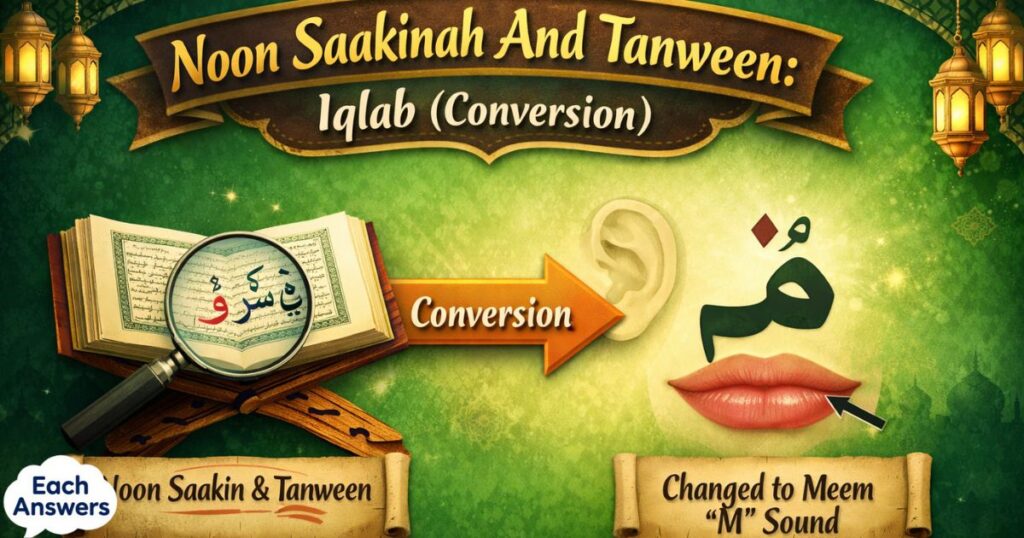
Iqlab means “to convert.” It applies in only one situation when Noon Saakinah or Tanween is followed by the letter ب (Ba). The Noon converts into a Meem-like nasal sound held for two counts. Just one letter triggers this entire rule.
The conversion isn’t random. Meem and Ba share the same articulation point the lips. So switching from Noon to a Meem sound before Ba creates a natural, smooth transition. Your lips close gently while the sound flows through your nose.
A perfect example is “سَمِيعٌۢ بَصِيرٌۢ.” The Tanween converts to a nasal Meem before Ba. Once you feel this rule in your mouth it becomes second nature. Practice slowly then gradually build speed.
Noon Saakinah And Tanween: Ikhfaa (Concealment)
Ikhfaa means “to hide.” It’s actually the most common Noon Saakinah rule in the entire Quran. When Noon or Tanween precedes any of 15 specific letters the Noon sound gets partially concealed not fully clear and not fully merged.
The 15 Ikhfaa letters are: ت، ث، ج، د، ذ، ز، س، ش، ص، ض، ط، ظ، ف، ق، ك
Think of Ikhfaa as the middle ground between Izhar and Idgham. The Noon isn’t fully pronounced nor fully swallowed. It hides with a light nasal hum held for two counts. “مِنْ شَرِّ” from Surah Al-Falaq demonstrates this beautifully.
Getting Ikhfaa right requires patience. The nasalization must be light not heavy. Many beginners either over-pronounce or completely drop the sound. Find that sweet middle spot and your recitation instantly sounds more polished.
Meem Saakinah Rules (Three Rules)
Meem Saakinah is the letter Meem carrying a sukoon mark. It follows three distinct rules depending on what letter comes after it. Each rule produces a different sound. Knowing which applies keeps your recitation clean and accurate.
Idgham Shafawi (Lip Merging)
Idgham Shafawi occurs when Meem Saakinah meets another Meem. The two Meems merge into one with Ghunnah. “لَهُم مَّا” is a classic example. Your lips come together and the nasal hum flows smoothly for two full counts.
Ikhfaa Shafawi (Lip Concealment)
When Meem Saakinah meets ب (Ba) Ikhfaa Shafawi applies. The Meem is concealed with nasalization. “تَرْمِيهِم بِحِجَارَةٍ” shows this perfectly. Your lips barely close while the nasal sound carries through gently.
Izhar Shafawi (Lip Clarity)
Izhar Shafawi covers all remaining 26 letters after Meem Saakinah. Simply pronounce the Meem clearly without any merging or hiding. “لَكُمْ فِيهَا” is a straightforward example. Clear, crisp and confident that’s Izhar Shafawi done right.
Noon And Meem Mushaddad (Doubled Letters)
When Noon or Meem carries a Shaddah mark it means the letter is doubled. Both must be pronounced with full Ghunnah a rich nasal resonance held for two complete counts. This is actually the strongest Ghunnah level in all tajweed rules.
“إِنَّ” and “ثُمَّ” are two of the most common examples. You’ll encounter them constantly throughout the Quran. Every time that Shaddah appears on Noon or Meem your nasalization must be full, round and deliberate never rushed or clipped.
Many beginners underestimate this rule. They read the doubled letter but skip the Ghunnah entirely. That’s a notable mistake. The nasal hum isn’t optional here it’s mandatory. Practice holding it for a steady two counts every single time.
Al-Madd (Prolongation/Elongation)
Al-Madd means extending vowel sounds beyond their natural length. It’s one of the most critical tajweed rules for maintaining the Quran’s melodious flow. The three Madd letters are ا، و، ي each linked to its corresponding vowel sound.
Madd Asli (Natural Prolongation)
Madd Asli is the foundation of all prolongation rules. It lasts exactly two counts and occurs when a Madd letter follows its matching vowel. “قَالَ” (qaala) holds the Alif for two steady counts. Simple, consistent and always two counts no exceptions.
Madd Far’i (Secondary Prolongation)
Madd Far’i branches into several subtypes with varying lengths from 2 to 6 counts.
| Type | Counts | Example |
| Madd Wajib Muttasil | 4-5 | جَاءَ |
| Madd Jaiz Munfasil | 2-5 | إِنَّا أَعْطَيْنَاكَ |
| Madd Lazim | 6 | الضَّالِّينَ |
| Madd Arid Lissukoon | 2-6 | الرَّحِيمِ (when stopping) |
Each subtype has a precise trigger. Madd Lazim always gets 6 counts no flexibility. Madd Arid Lissukoon allows some variation depending on your chosen recitation style. Learn each trigger clearly before worrying about count lengths.
Qalqalah (Bouncing/Echo Sound)
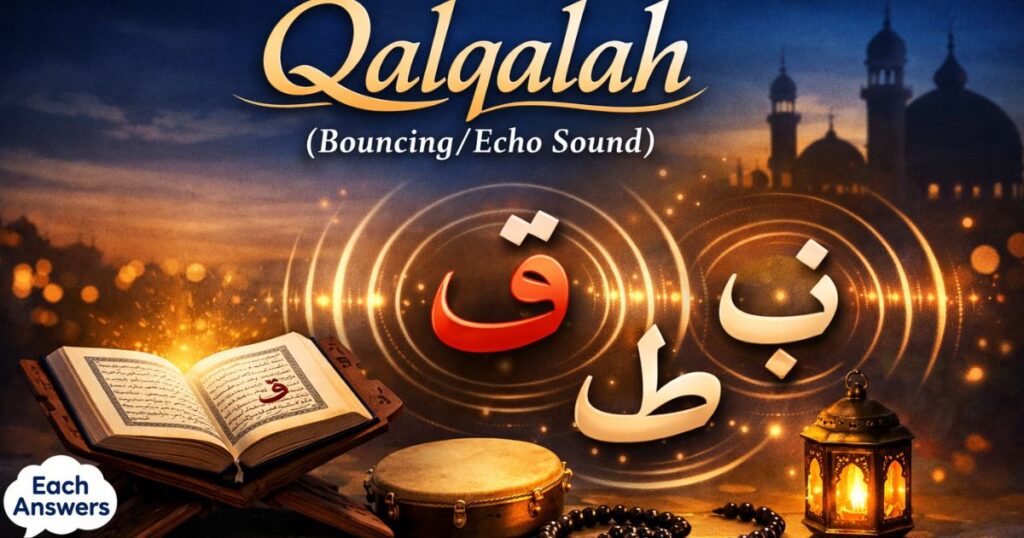
Qalqalah creates a distinct bouncing echo on five specific letters. It adds remarkable depth and harmony to recitation. The five letters are remembered through the phrase قُطْبُ جَدٍّ ق، ط، ب، ج، د. Encounter any of these with sukoon and Qalqalah activates immediately.
There are three intensity levels. Qalqalah Kubra is the strongest and occurs when stopping on one of these letters. “الْفَلَقِ” at the end of a verse is a powerful example. Qalqalah Wusta is moderate and occurs mid-word with Shaddah.
Qalqalah Sughra is the lightest and happens mid-word without stopping. “أَقْبَلَ” demonstrates this subtly. The echoing sound must feel natural never exaggerated. Overdoing Qalqalah sounds awkward so keep it controlled and intentional.
Tafkheem And Tarqeeq (Heavy And Light Pronunciation)
Tafkheem means pronouncing letters with heaviness and fullness. Tarqeeq means keeping them light and thin. Seven letters always carry Tafkheem remembered by the phrase خُصَّ ضَغْطٍ قِظْ. Every other letter defaults to Tarqeeq unless a rule says otherwise.
The seven heavy letters are: خ، ص، ض، ط، ظ، غ، ق. “الصَّلَاةَ” and “قُلْ” demonstrate Tafkheem clearly. Your tongue rises toward the back of your mouth creating that rich full sound. It’s a physical sensation you can actually feel.
The letter ر (Raa) is a special case. It takes Tafkheem with Fatha or Dammah like “رَبِّ.” It takes Tarqeeq with Kasra like “رِزْقًا.” This flexibility makes Raa one of the trickiest letters to consistently get right.
Laam Saakinah Rules
Laam Saakinah follows special rules depending on its context. The most significant application involves Allah’s blessed name and the Arabic definite article ال. Getting Laam right in these contexts carries deep spiritual and linguistic importance.
In Allah’s name the Laam is heavy (Tafkheem) when preceded by Fatha or Dammah. “رَسُولُ اللَّهِ” carries a full heavy Laam. But when preceded by Kasra like “بِسْمِ اللَّهِ” the Laam becomes light (Tarqeeq). Context completely controls the sound.
The definite article ال divides into two categories. Laam Shamsiyyah (Sun Letters) silences the Laam “الشَّمْسُ” becomes “Ash-shamsu.” Laam Qamariyyah (Moon Letters) keeps the Laam clearly pronounced “الْقَمَرُ” stays “Al-qamaru.” Memorize both letter groups and you’ll never confuse them again.
Waqf And Ibtida’ (Stopping And Starting)
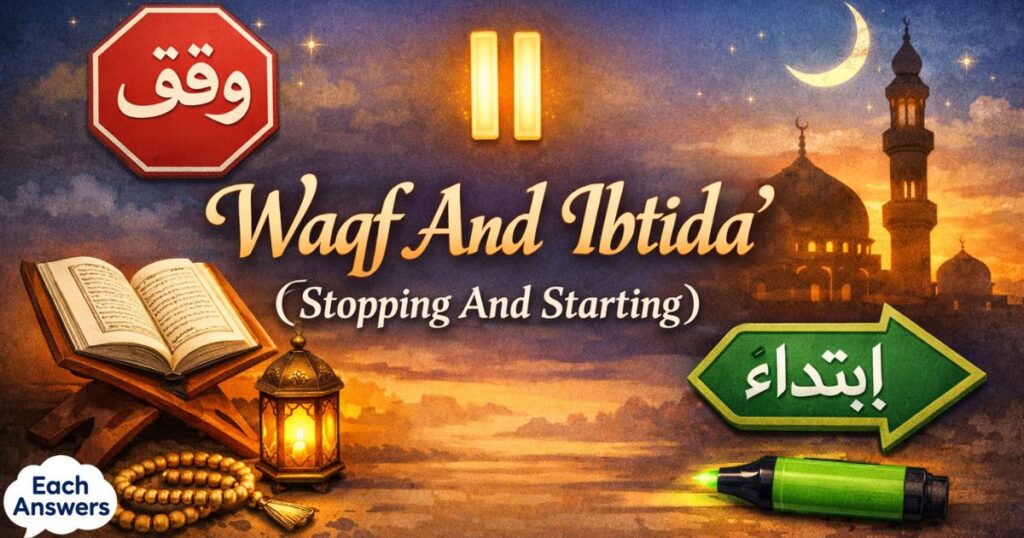
Waqf governs how and where you stop during recitation. Ibtida’ governs how you resume. Together these rules protect the meaning of Allah’s words from distortion through careless pausing. Stopping at the wrong place can completely reverse a verse’s intended message.
| Symbol | Type | Meaning |
| مْ | Waqf Lazim | Must stop here |
| ج | Waqf Ja’iz | May stop or continue |
| لا | Waqf Mamnu’ | Do not stop |
| ص | Waqf Mujawwaz | Better to continue |
When stopping the final vowel becomes sukoon. Feminine Ta (ة) transforms into Ha (ه) so “رَحْمَةً” becomes “rahmah.” When resuming never start mid-phrase. Always begin from a point that preserves complete and clear meaning for the listener.
Learning Timeline And Practice Tips
Most learners reach basic Tajweed competency within 12 months when they follow a structured path. Beginners spend the first three months mastering Makharij and basic Noon and Meem rules. Building this foundation early makes every advanced rule easier to absorb later.
From months three to six focus on all four Noon Saakinah rules, Qalqalah and Tafkheem. These rules appear constantly throughout the Quran so practicing them brings immediate visible improvement. Listen daily to skilled reciters like Mahmoud Khalil Al-Husary or Mishary Alafasy for inspiration.
Advanced learners spend months six through twelve perfecting Madd variations and Waqf placement. Record yourself regularly and compare your recitation honestly with professionals. Ten to fifteen minutes of focused daily practice consistently beats occasional long sessions every single time.
Common Mistakes To Avoid In Learning Tajweed Rules
The most damaging mistake beginners make is ignoring Makharij entirely. Pronouncing letters from wrong positions corrupts meaning at the root level. Fix articulation points first and every other tajweed rule becomes significantly easier to apply correctly.
Skipping Ghunnah is another widespread error. Many students read Noon and Meem Mushaddad without any nasal resonance. That missing hum isn’t cosmetic it’s an obligatory part of the recitation. Similarly incorrect Madd lengths too short or too long disrupt the Quran’s natural melodic rhythm.
Confusing similar letters like ص and س or ق and ك trips up countless learners. These pairs sound deceptively alike to untrained ears but carry completely different meanings. Deliberate slow practice targeting these specific pairs eliminates confusion faster than general recitation practice ever will.
Why Tajweed Matters
The Prophet Muhammad ﷺ said that one who recites the Quran beautifully and precisely will be in the company of noble angels (Sahih Al-Bukhari). That’s the ultimate motivation for mastering tajweed rules. It’s not about perfection it’s about sincere and careful effort.
Tajweed rules preserve the divine revelation exactly as it was transmitted. Without them meaning shifts, words morph and the sacred text loses its precise integrity. Most scholars consider applying proper tajweed an individual obligation Fard ‘Ayn upon every Muslim who recites the Quran.
Beyond obligation tajweed deepens your spiritual connection with Allah’s words. When your tongue moves correctly and your breath flows naturally through each letter something profound happens. Recitation transforms from a routine act into a deeply moving spiritual experience worth every moment of practice.
FAQ’S
What exactly are tajweed rules?
Tajweed rules are precise guidelines for reciting the Quran correctly. They govern pronunciation, breath control and articulation so every letter sounds exactly right.
Are tajweed rules mandatory for every Muslim?
Most scholars consider tajweed rules an individual obligation. Every Muslim who recites the Quran must apply them to preserve the sacred text’s exact meaning.
How long does learning tajweed rules take?
Most learners achieve basic tajweed rules competency within three to six months. Full mastery typically takes up to twelve months of consistent daily practice.
Can beginners learn tajweed rules without a teacher?
While resources help beginners start learning tajweed rules independently a qualified teacher remains essential. Only a teacher can correct your pronunciation errors accurately and effectively.
Why do tajweed rules matter so much in recitation?
One mispronounced letter can completely flip a word’s meaning. Tajweed rules protect Allah’s words from distortion and deepen your spiritual connection during every recitation.
Conclusion
Learning the 14 Types of Tajweed Rules with Examples (Complete Guide) Perfect Quran Recitation isn’t just an academic exercise. It’s a lifelong commitment to Allah’s words. Tajweed rules transform ordinary recitation into something truly beautiful. Every rule matters. Every letter counts.
Don’t let tajweed rules overwhelm you. Start small. Stay consistent. These tajweed rules have been preserved for centuries so you can recite exactly as the Prophet ﷺ recited. Apply tajweed rules daily and watch your connection with the Quran deepen in ways you never expected. The journey starts with a single letter.