
Some words stop you cold. Wallahi meaning is exactly that kind of word. It’s an Arabic oath meaning “I swear by Allah.” Not a filler. Not slang. A soul-deep declaration of truth that Muslims have honored for centuries.
Here’s what makes wallahi meaning so powerful. When someone says it, they’re not just talking they’re summoning God as their witness. That’s not something you do lightly. The wallahi meaning runs straight through a Muslim’s faith, honor, and integrity. It shows up in life’s weightiest moments a solemn promise, a fierce denial, an unshakeable testimony. Imagine staking everything you believe in on a single statement. That’s wallahi meaning in its truest form.
What Does Wallahi Meaning? And Usage Explained
Wallahi meaning is simple yet profound. It’s an Arabic oath that means “I swear by Allah.” Muslims use it to confirm truth with complete sincerity. It’s not just a word it’s a binding declaration.
The wallahi meaning goes beyond everyday speech. It carries centuries of religious weight. When someone says wallahi, they’re making a serious commitment before God. That’s not something taken lightly.
Usage matters just as much as meaning. Wallahi isn’t for trivial conversations. It belongs in moments of truth, promise, and honor. Use it wrongly and you’ve crossed a serious line in Islamic faith.
The Deepest Significance: Wallahi Meaning In Islam
In Islam, wallahi meaning represents a formal oath called Qasam. It invokes Allah as the ultimate witness. This transforms a simple statement into a sacred contract between the speaker and God.
Taking a false wallahi oath is a major sin. Islamic scholars classify it among the gravest offenses. The Prophet Muhammad ﷺ warned believers sternly against using Allah’s name to support a lie.
The wallahi meaning also triggers real religious consequences. Break a sincere oath and you owe Kaffarah an expiation. That might mean feeding the poor or fasting. Islam treats every oath as spiritually binding.
Wallahi Meaning In English
Learn more:Alhamdulillah: Meaning, and Daily Use
Wallahi meaning in English translates most directly as “I swear by Allah” or “By God.” Simple enough on the surface. But those English phrases don’t carry the same sacred weight as the original Arabic oath.
English phrases like “I swear” have become throwaway expressions. People say them constantly without meaning anything serious. Wallahi is different it’s never meant to be casual or empty.
Here’s a quick look at how wallahi meaning compares in English context:
| Arabic Term | English Translation | Weight |
| Wallahi | I swear by Allah | Sacred oath |
| By God | General exclamation | Often casual |
| I swear | Informal emphasis | Rarely serious |
| I promise | Personal commitment | Moderate weight |
Origin And Definition Of Wallahi
Wallahi meaning has ancient roots in Arabian culture. Before Islam, Arabs swore oaths by tribal leaders and idols. Islam transformed that tradition completely. It redirected all oaths exclusively toward Allah.
The Prophet Muhammad ﷺ made this crystal clear. He forbade swearing by anyone other than God. “Whoever takes an oath should swear by Allah or stay silent.” That single teaching changed everything about oath-taking forever.
Here’s the cleanest definition of wallahi meaning: a solemn verbal oath where a Muslim calls Allah as witness to their truthfulness. It’s faith, integrity, and accountability wrapped into one powerful word.
Wallahi In The Quran
Allah Himself takes oaths throughout the Quran. He swears by the sun, the night, the fig, and the olive. These divine oaths grab attention and emphasize profound truths with breathtaking authority.
Humans follow a different rule entirely. Created beings can only swear by the Creator. Swearing by anything else contradicts Tawhid the absolute oneness of Allah. That distinction matters deeply in Islamic theology.
Surah Al-Ma’idah (5:89) addresses broken oaths directly. It outlines Kaffarah as the required expiation. This Quranic legislation proves that oaths aren’t suggestions they’re binding commitments with real spiritual consequences attached.
The Practical Guide: How And When To Use Wallahi
Wallahi belongs in serious situations only. Two principles govern its use sincerity and necessity. You must be completely certain of the truth before invoking Allah’s name. No exceptions exist here.
Don’t use wallahi as a filler word. Dropping it into everyday small talk disrespects Allah’s name. Reserve it for moments that genuinely demand absolute certainty or a deeply binding commitment.
| ✅ Appropriate Use | ❌ Inappropriate Use |
| Truthful testimony | Casual conversation |
| Solemn promise | Selling products |
| Defending honor | Trivial opinions |
| Court oath | Supporting a lie |
| Vow to Allah | Swearing to sin |
When To Say Wallahi
Timing is everything with wallahi. Say it when truth absolutely must be established. Say it when your credibility is genuinely at stake. Never say it because it sounds dramatic or convincing.
Consider situations involving serious accusations, legal testimony, or binding promises. These are wallahi moments. Your words carry divine weight here so every syllable demands intentional thought before speaking.
Ask yourself one thing before saying wallahi would you stake your relationship with Allah on this statement. If hesitation creeps in, don’t say it. Silence is always safer than a careless oath.
Scenario 1: Bearing Witness (Shahada)
Witnessing an accident or crime puts you in a position of serious responsibility. Your testimony can change someone’s life. Wallahi here signals to everyone that your account is truthful and completely reliable.
Imagine a false accusation in court. One honest witness steps forward. “Wallahi, I saw exactly what happened.” That single oath carries enormous moral and spiritual authority in Islamic tradition.
Bearing witness is a sacred duty in Islam. Using wallahi during testimony isn’t dramatic it’s appropriate. It tells the listener that Allah Himself stands behind every word you’re about to say.
Scenario 2: Making A Solemn Vow Or Promise
Promises made with wallahi aren’t ordinary promises. They become binding vows before God. “Wallahi, I’ll repay you by Friday” transforms a simple commitment into something spiritually unbreakable.
This matters especially in relationships built on trust. A friend in crisis needs genuine reassurance. Wallahi delivers that. It says this isn’t empty comfort. This is a real, God-witnessed commitment.
Break that vow without valid reason and Kaffarah becomes necessary. That accountability is exactly the point. Wallahi raises the stakes intentionally so your promises carry genuine, lasting weight.
Scenario 3: Defending One’s Honor And Integrity
False accusations can destroy reputations instantly. Sometimes a simple denial just isn’t enough. Wallahi becomes a powerful shield when your character faces serious and unjust attack.
“Wallahi, I never said that about you.” Those words hit differently. They tell the listener you’re placing your faith and integrity completely on the line. That’s a bold statement only truth can support.
Honor matters deeply in Islamic culture. Defending it with wallahi isn’t arrogance it’s sincerity. You’re not just defending yourself. You’re asking Allah to witness your innocence before everyone present.
How To Swear Using Wallahi
1. The Intention (Niyyah)
Every act in Islam starts with intention. Before saying wallahi, your heart must consciously decide to make a formal oath. Without sincere niyyah, the words lack their true spiritual meaning and weight.
This internal state separates a genuine oath from an accidental utterance. Saying wallahi while joking doesn’t carry the same consequence. But if intent is present, the oath becomes immediately binding before Allah.
Niyyah isn’t complicated it’s clarity of purpose. You know in your heart what you’re doing. That honest awareness is what activates the full spiritual and moral weight of the wallahi oath.
2. The Utterance (Lafẓ)
Speak it clearly. “Wallahi, I did not take the money.” The statement must be specific and unambiguous. Vague oaths create confusion and don’t fulfill the requirements of a valid Islamic Qasam.
Three forms exist Wallahi, Billahi, and Tallahi. All invoke Allah’s name formally. Each carries identical weight. The choice between them is often regional or stylistic rather than theological.
Your words must match your intention perfectly. Say exactly what you mean. A precise utterance protects you spiritually and ensures the listener fully understands the commitment you’re making before God.
3. Understanding The Consequences
Swearing falsely is a major sin full stop. It’s called al-yamīn al-ghamūs, meaning it “plunges” the swearer into spiritual destruction. Understanding this before speaking protects you from serious harm.
Future promises sworn with wallahi carry Kaffarah obligations if broken. Feeding ten poor people, clothing them, or fasting three days these aren’t symbolic gestures. They’re real acts of atonement required by Islamic law.
Knowing the consequences isn’t meant to frighten you away from oaths entirely. It’s meant to sharpen your awareness. Every wallahi you utter deserves the full weight of understanding behind it.
Common Misconceptions About Wallahi
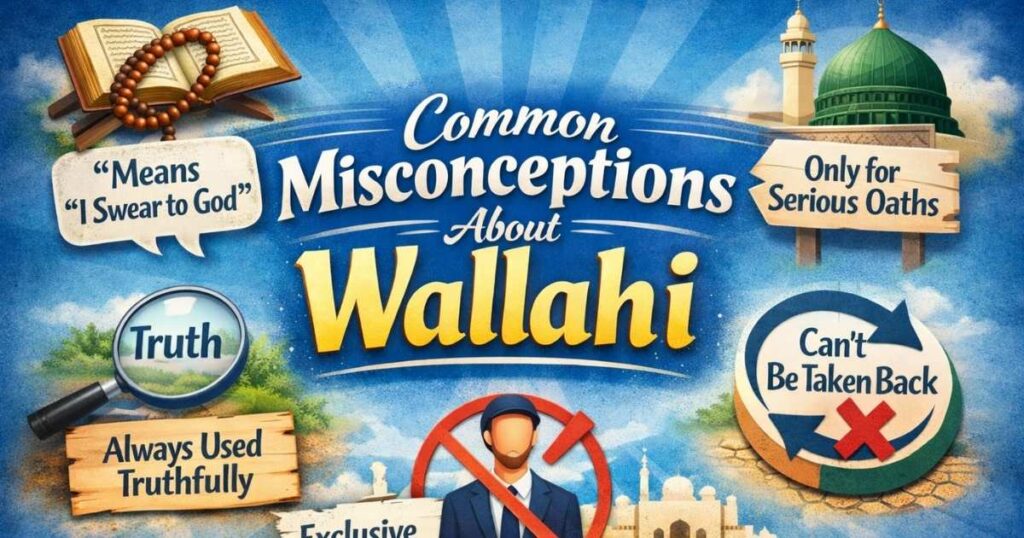
Myth 1: “It’s Just A Slang Word Like ‘I Swear’ Or ‘For Real'”
This misconception spreads fast especially online. People hear wallahi in videos and assume it’s Arabic slang. It isn’t. It’s a formal religious oath with theological roots stretching back centuries in Islamic tradition.
Calling wallahi slang is like calling a courtroom oath a casual comment. The structure, the intent, and the consequences are completely different. Context doesn’t make it casual proper usage keeps it sacred.
Respecting wallahi meaning starts with understanding what it actually is. It’s not a cultural quirk or internet expression. It’s a living, breathing act of faith that connects a Muslim’s words directly to their Creator.
Myth 2: “You Can Say It For Anything To Make People Believe You”
Some people weaponize wallahi to sound more convincing. That’s a dangerous misuse. Using it to deceive someone isn’t just socially wrong it’s spiritually catastrophic in Islamic theology.
Al-yamīn al-ghamūs isn’t a minor offense. The Prophet ﷺ placed it among the gravest sins a Muslim can commit. Manipulating Allah’s name to push a lie crosses a line that demands serious repentance.
Wallahi builds trust it doesn’t manufacture it. If you’re using it to compensate for weak credibility, you’ve already missed the point entirely. Truth must come first. Wallahi simply seals it.
Myth 3: “Wallah And Wallahi Are Exactly The Same Thing”
They’re close but not identical. Wallahi is grammatically precise the formal oath form. Wallah is colloquial and flexible. Native speakers often use wallah simply to express surprise or general emphasis.
Think of it this way. Wallahi is the signed contract. Wallah is sometimes just a verbal exclamation. Both invoke Allah’s name but wallahi carries the stronger and more unambiguous connotation of a binding oath.
Using wallah to lie still carries sin. Don’t mistake its casual frequency for spiritual lightness. However wallahi remains the gold standard when a formal, deliberate, and fully binding oath is genuinely intended.
Wallahi In Different Arabic Dialects
Wallahi travels across the Arab world but lands differently everywhere. In the Levant Lebanon, Syria, Jordan it’s woven into daily conversation naturally. Frequency is high but the sacred meaning never fully disappears beneath familiarity.
Gulf countries treat wallahi with notable gravity. Saudi Arabia, UAE, and Kuwait use it often yet the social consequence of a false wallahi remains deeply serious. Cultural respect for the oath stays strong and visible.
North Africa tells a slightly different story. French colonial influence and local dialects mean wallahi appears less frequently in some Maghreb regions. Yet every Muslim from Morocco to Egypt instantly recognizes its sacred weight and responds accordingly.
FAQ’S
What does wallahi meaning actually mean?
Wallahi meaning translates to “I swear by Allah.” It’s a sacred Arabic oath Muslims use to confirm absolute truth and sincerity.
Is wallahi meaning just casual slang?
Absolutely not. Wallahi meaning represents a formal religious oath. Using it carelessly or dishonestly is considered a serious sin in Islam.
Why do Muslims take the wallahi meaning so seriously?
Because it invokes Allah as a direct witness. That’s not symbolic it’s a spiritually binding commitment with real consequences attached.
Can anyone use wallahi meaning or only Muslims?
Wallahi meaning belongs specifically to Islamic faith. Non-Muslims saying it without understanding its sacred weight risks trivializing a deeply serious religious commitment.
What happens if someone breaks a wallahi meaning oath?
Breaking a sincere wallahi oath requires Kaffarah an expiation. That means feeding the poor, clothing ten people, or fasting three consecutive days.
Conclusion
Wallahi meaning is more than a phrase. It’s a sacred oath rooted in centuries of Islamic faith. This guide Wallahi Meaning, Usage & Culture | NoorPath Academy covers everything you need to know. Wallahi meaning connects your words directly to Allah. That’s powerful.
Never take wallahi meaning lightly. It’s not slang. It’s not filler. Every time someone says wallahi, they’re placing their integrity before God. The wallahi meaning carries truth, honor, and accountability in every single syllable. Understand it fully. Use it wisely. Respect it always.