
Nearly 2 billion people wake up every single day guided by the same timeless truth. That’s the raw power of islamic facts they don’t sit quietly in history books. They pulse through daily prayers, charitable giving and unwavering faith in Allah. These islamic facts aren’t dusty knowledge. They’re a living roadmap for humanity.
Here’s what makes islamic facts truly remarkable. For over 1,400 years, nothing has shaken their foundation. The five pillars, the six articles of faith, Prophet Muhammad’s extraordinary life these islamic facts shape how Muslims breathe, think and worship. Whether you’re a lifelong believer or a curious newcomer, diving into these islamic facts doesn’t just inform you. It genuinely transforms you from the inside out.
Key Facts Every Muslim Should Know
Islam stands as one of the world’s most complete ways of life. Its facts cover faith, worship, history and daily conduct. Every Muslim benefits deeply from knowing these core truths.
These facts aren’t complicated. They’re beautifully simple yet profoundly meaningful. Understanding them builds a stronger, more conscious relationship with Allah.
From the five pillars to prophetic history, these facts shape Muslim identity. They guide millions daily. Every sincere believer deserves to know them well.
What Is Islam?
Islam means “submission to Allah.” It’s a complete way of life, not just a religion. Over 1,400 years ago, Prophet Muhammad delivered this divine message to humanity.
Islam teaches pure monotheism. There’s only one God Allah. No partners, no equals, no intermediaries. This simple truth forms the heart of everything Islam stands for.
Islam isn’t just rituals. It covers morality, justice, family life and personal conduct. It provides Muslims with a clear, purposeful framework for living every single day.
What Do Muslims Believe?
Muslims follow six core articles of faith called Iman. These beliefs form the foundation of Islamic thought. Without them, a Muslim’s faith remains incomplete and unstructured.
These articles cover belief in Allah, angels, divine books, messengers, the Day of Judgment and divine decree. Each one carries deep spiritual significance. Together they paint a complete picture of Islamic belief.
Understanding these beliefs helps Muslims navigate life with clarity and purpose. They answer life’s biggest questions who created us, why we’re here and where we’re going.
Belief In Allah
Allah is the one true God eternal, all-knowing and incomparable. Believing in His absolute oneness is called Tawhid. It’s the most fundamental concept in all of Islam.
Muslims believe Allah has no partners, no children and no parents. He’s unlike anything in creation. His 99 beautiful names reveal His mercy, power and wisdom perfectly.
This belief transforms everything. When a Muslim wakes up, works, eats or sleeps Allah’s presence guides every moment. It’s not just belief. It’s a deeply personal relationship.
Belief In His Angels (Mala’Ikah)
Angels are real spiritual beings created from light. They’re perfectly obedient to Allah and never disobey Him. Muslims must believe in their existence as part of true faith.
Each angel carries a specific role. Jibril delivered divine revelation. Mikail oversees rain and provision. Israfil will blow the trumpet on Judgment Day. Their duties serve Allah’s grand design.
Two angels Kiraman Katibin record every human deed. Good and bad, nothing escapes their record. This belief encourages Muslims to act righteously even when nobody’s watching.
Belief In His Divine Books (Kutub)
Allah sent sacred scriptures to guide humanity throughout history. These divine books carried His direct guidance to different nations and prophets across different eras of time.
The Torah, Psalms, Gospel and Qur’an are among these holy scriptures. Each was revealed to a specific prophet. However, the Qur’an remains the only perfectly preserved divine book today.
Muslims believe all original divine books came from the same source Allah Himself. Believing in them all is obligatory. The Qur’an supersedes them all as the final, complete revelation.
Belief In His Messengers (Rusul)
Allah sent prophets to every nation throughout human history. From Adam to Muhammad, each messenger carried the same essential message worship Allah alone. Muslims must believe in all of them.
There were 124,000 prophets according to Islamic tradition. However only 25 are mentioned by name in the Qur’an. Each one was human, chosen specifically by Allah for his mission.
Rejecting even one prophet invalidates a Muslim’s faith. This belief fosters deep respect for all divine messengers. It also connects Islam beautifully to Judaism and Christianity through shared prophetic heritage.
Belief In The Day Of Judgment (Yawm Al-Qiyamah)
Every soul will face Allah on the Day of Judgment. Every deed big or small gets weighed with perfect divine justice. Nothing escapes Allah’s all-seeing awareness on that tremendous day.
This belief instills genuine moral responsibility in every Muslim. It’s not about fear alone. It’s about living purposefully, knowing accountability is absolutely inevitable for every human being.
The Day of Judgment separates this life from eternal life. Those who believed and did good enter paradise. Those who rejected truth face consequences. This belief makes every choice meaningful.
Belief In Divine Decree (Qadr)
Qadr means Allah knows and controls everything that happens in the universe. Nothing occurs outside His divine will and knowledge. This belief is the sixth and final article of faith.
Qadr doesn’t eliminate free will. Humans still make real choices and bear real responsibility. However, the ultimate outcome of everything rests firmly in Allah’s hands alone.
Believing in Qadr brings extraordinary peace during hardship. When life gets painful, a Muslim trusts Allah’s plan completely. That trust transforms anxiety into patience and genuine spiritual contentment.
Facts Every Muslim Should Know
Some islamic facts are so essential that every Muslim must know them by heart. They cover worship, history and daily practice. Ignoring them weakens a Muslim’s foundation significantly.
These facts range from the basics of prayer to the history of the Qur’an. They cover prophets, pillars and pivotal historical moments. Together they form a complete picture of Islamic life.
Think of these facts as your spiritual toolkit. The more you know them, the stronger your faith grows. They’re not just information they’re transformative knowledge that shapes a righteous Muslim life.
Who Is Allah?
Allah is the Arabic name for the one true God. He’s the Creator of everything the galaxies, the oceans, every living soul. Nothing exists without His will and permission.
He’s described through 99 beautiful names in the Qur’an. Ar-Rahman means the Most Merciful. Al-Ghafur means the Most Forgiving. Each name reveals a stunning dimension of His divine character.
Allah isn’t distant or unreachable. The Qur’an says He’s closer to you than your own jugular vein. That’s not poetry that’s a profound spiritual reality every Muslim should deeply internalize.
What Is The Qur’an?
The Qur’an is the literal word of Allah revealed to Prophet Muhammad through Angel Jibril. Its revelation spanned 23 years. It remains perfectly preserved in its original Arabic language today.
No other scripture in history matches the Qur’an’s preservation. Every word, every letter remains unchanged since its revelation over 1,400 years ago. That’s genuinely extraordinary by any historical standard.
The Qur’an covers theology, law, morality and history. It guides personal life and community affairs equally. For millions of Muslims daily, it’s the ultimate source of comfort, wisdom and divine direction.
Who Is Prophet Muhammad?
Prophet Muhammad was born in Mecca in 570 CE. He was known for his remarkable honesty long before prophethood. At age 40, Angel Jibril delivered Allah’s first revelation to him.
He wasn’t divine he was beautifully human. Yet his character was extraordinary. His patience, generosity, justice and compassion set a timeless standard for every Muslim to follow faithfully.
His life called the Seerah is Islam’s practical manual. Everything from how he prayed to how he treated others teaches Muslims how to live. Studying his life is genuinely transformative.
What Are The Five Pillars Of Islam?
The five pillars are Islam’s foundational acts of worship. They structure a Muslim’s entire life around faith and obedience to Allah. Every able Muslim must uphold all five pillars.
| Pillar | Arabic Name | Meaning |
| Declaration of Faith | Shahada | Testifying Allah is one |
| Daily Prayer | Salah | Five prayers daily |
| Charity | Zakat | Giving 2.5% of wealth |
| Fasting | Sawm | Fasting during Ramadan |
| Pilgrimage | Hajj | Visiting Mecca once |
These five pillars aren’t burdens. They’re spiritual anchors that keep a Muslim connected to Allah through every season of life.
What Is Salah In Islam?
Salah is the ritual prayer performed five times every single day. It’s a direct, intimate conversation with Allah. No middleman, no priest just you and your Creator communicating purely.
The five prayers are Fajr, Dhuhr, Asr, Maghrib and Isha. Each involves standing, bowing and prostrating before Allah. Every movement carries deep symbolic meaning and profound spiritual significance.
Salah isn’t just routine. It’s a spiritual reset button pressed five times daily. It pulls a Muslim away from worldly noise and refocuses the heart entirely on what truly matters most.
What Is The Islamic Testimony Of Faith (Shahada)?
Learn more:Right Age to Start Online Hifz?
The Shahada is Islam’s declaration of faith. It states: “There is no deity worthy of worship except Allah and Muhammad is His messenger.” Saying it sincerely makes someone a Muslim immediately.
This simple statement carries enormous theological weight. It rejects every false deity and affirms Allah’s absolute oneness. It simultaneously confirms Prophet Muhammad’s role as the final divine messenger to humanity.
Muslims repeat the Shahada throughout their lives in prayer, at birth and at death. It’s not just words. It’s the defining statement of a Muslim’s entire identity and spiritual existence.
Why Do Muslims Pray Daily?
Muslims pray five times daily because Allah commands it directly in the Qur’an. It’s an act of gratitude, obedience and love. Prayer keeps a Muslim spiritually alive and morally grounded.
Think of daily prayer like nourishment. Just as the body needs food, the soul needs Salah. Skipping it weakens spiritual health gradually often without a person even noticing the decline.
Prayer also builds incredible discipline. When you organize your entire day around five prayer times, priorities shift naturally. Worldly distractions shrink and Allah’s remembrance grows stronger with every passing prayer.
What Is Zakat?
Zakat is mandatory annual charity given by financially eligible Muslims. It equals 2.5% of a Muslim’s surplus savings held for one full lunar year. It’s the third pillar of Islam.
| Zakat Basics | Details |
| Percentage | 2.5% of savings |
| Frequency | Once per lunar year |
| Recipients | Poor, needy, debtors and more |
| Purpose | Purify wealth and help others |
Zakat isn’t just charity. It’s a powerful economic system designed by Allah to reduce poverty, distribute wealth fairly and build genuine compassion within every Muslim community worldwide.
What Is Sadaqa?
Sadaqa is voluntary charity given freely at any time. Unlike Zakat, there’s no fixed amount or specific schedule. Any generous act done sincerely for Allah’s pleasure counts as Sadaqa.
Sadaqa isn’t limited to money. Helping someone carry groceries is Sadaqa. Smiling at a stranger counts too. Even removing a harmful object from the road earns divine reward from Allah.
The beauty of Sadaqa lies in its flexibility. Rich or poor, everyone can give. A kind word costs nothing yet carries immense spiritual weight. That’s what makes Sadaqa so beautifully accessible to all.
What Holidays Do Muslims Celebrate?
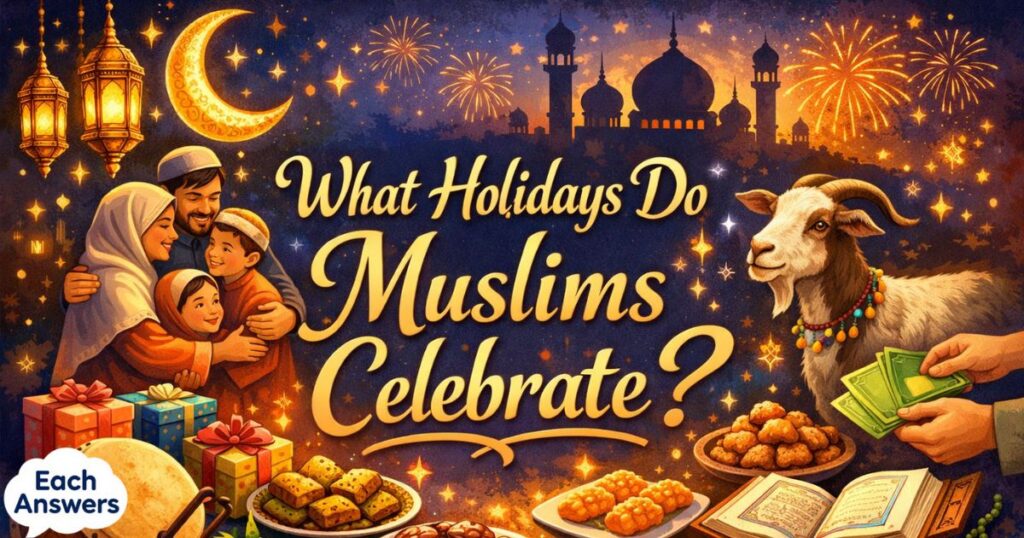
Muslims celebrate two major holidays called Eids. Both involve special prayers, family gatherings, festive meals and expressions of gratitude to Allah. They’re joyful communal celebrations deeply rooted in Islamic tradition.
Beyond the two Eids, Ramadan itself carries a deeply celebratory spirit. The entire month pulses with community, generosity and spiritual energy. Muslims worldwide eagerly anticipate it every single year.
These celebrations aren’t just cultural customs. Each one connects directly to a pillar or profound moment in Islamic history. They keep Muslims grounded in faith while celebrating together as one united Ummah.
Eid Al-Fitr
Eid al-Fitr marks the end of Ramadan’s month-long fast. It’s a joyful three-day celebration beginning with a special congregational morning prayer. Muslims dress beautifully and gather with family and friends.
Gifts are exchanged and delicious food fills every table. Before Eid prayer, Muslims must give Zakat al-Fitr a small charity ensuring even the poorest families can celebrate joyfully alongside everyone else.
The spirit of Eid al-Fitr is gratitude and community. After 30 days of fasting and worship, Muslims emerge spiritually refreshed. It’s a beautiful collective exhale of faith, joy and heartfelt thankfulness to Allah.
Eid Al-Adha
Eid al-Adha honors Prophet Ibrahim’s extraordinary willingness to sacrifice his son for Allah. It’s celebrated during the Hajj season and lasts four days. Muslims worldwide join this magnificent celebration together.
The highlight is the Qurbani sacrificing a sheep, goat or cow. The meat gets divided into three portions for family, neighbors and the poor. Nobody goes hungry during this generous occasion.
Eid al-Adha teaches the ultimate lesson of sacrifice and surrender to Allah’s will. It’s not about the animal. It’s about proving that nothing absolutely nothing matters more than obedience to Allah.
Ramadan
Ramadan is the ninth month of the Islamic lunar calendar. It’s the holiest month in Islam the month Allah chose to reveal the Qur’an to Prophet Muhammad for the very first time.
Muslims fast from dawn to sunset every single day throughout Ramadan. No food, no water, no negative speech. It’s a full spiritual detox for the body, mind and soul simultaneously.
Ramadan transforms the atmosphere completely. Mosques overflow with worshippers nightly. Generosity multiplies everywhere. Families gather for Iftar meals at sunset. The entire month radiates a warm, communal spiritual energy unlike anything else.
Why Do Muslims Have To Fast For A Full Month?
A full month of fasting builds lasting discipline not just temporary willpower. Thirty consecutive days rewire habits, sharpen focus and cultivate God-consciousness called Taqwa deeply within a Muslim’s heart and character.
Short fasts wouldn’t achieve the same transformation. The sustained spiritual effort of an entire month is precisely what makes Ramadan’s impact so profound and long-lasting for every sincere Muslim.
Fasting also builds genuine empathy. When you experience hunger deliberately, your heart softens toward those who face it involuntarily every day. That empathy naturally drives increased charity, kindness and generosity throughout Ramadan.
What Is The Significance Of The Hajj Pilgrimage?
Hajj is the fifth pillar of Islam a once-in-a-lifetime pilgrimage to Mecca. Every financially and physically able Muslim must perform it at least once. Its spiritual significance is absolutely extraordinary.
Millions gather wearing identical simple white garments. No rich, no poor everyone stands equal before Allah. That powerful visual alone dismantles every barrier of race, nationality and social status completely.
Hajj rituals trace directly back to Prophet Ibrahim’s legacy. Circling the Kaaba, standing at Arafat, casting stones at the Jamarat each act carries deep historical and spiritual meaning for every pilgrim.
When Was The Islamic Calendar Introduced?
The Islamic calendar was introduced around 638 CE under Caliph Umar ibn al-Khattab. He needed a standardized system to date official correspondence and important community events across the growing Islamic state.
After consulting senior companions, Umar chose the Hijra Prophet Muhammad’s migration from Mecca to Medina in 622 CE as the calendar’s starting point. That migration marked Islam’s new era as a community.
The Islamic calendar is lunar-based. Each month begins with the sighting of the new crescent moon. This makes the Islamic year approximately 11 days shorter than the standard Gregorian solar calendar used globally.
Who Accepted Islam First?
Khadijah bint Khuwaylid the Prophet’s devoted wife was the very first person to accept Islam. When Muhammad returned trembling from his first revelation, she believed him immediately without a single moment of hesitation.
Following Khadijah, three others accepted Islam early on. Ali ibn Abi Talib was the first child to embrace Islam. Zayd ibn Harithah was the first freed slave. Abu Bakr was the first free adult man.
| First Muslims | Category |
| Khadijah | First overall and first woman |
| Ali ibn Abi Talib | First child |
| Zayd ibn Harithah | First freed slave |
| Abu Bakr | First free adult man |
When Was The Quran First Revealed?
The Qur’an’s first revelation came in 610 CE during Ramadan’s final ten nights. Prophet Muhammad was meditating alone in the Cave of Hira on Mount Jabal al-Nour near Mecca when it happened.
Angel Jibril appeared and commanded “Iqra!” meaning “Recite!” Muhammad, being unlettered, was overwhelmed. The angel embraced him firmly three times before reciting the opening verses of Surah Al-Alaq to him.
Those first five verses changed human history forever. They began with “Recite in the name of your Lord who created.” Knowledge, learning and Allah’s name intertwined beautifully in Islam’s very first divine words.
How Was The Quran Revealed And Compiled?
Allah revealed the Qur’an gradually over 23 years not all at once. Each revelation addressed specific events, questions or needs of the early Muslim community. This gradual approach made implementation practical and spiritually manageable.
During the Prophet’s lifetime, companions memorized verses and wrote them on palm leaves, bones and parchment. After his death, Abu Bakr ordered the first official compilation into a single written volume to preserve it.
Later, Caliph Uthman standardized one master copy based on the Quraysh dialect. Copies were distributed across the Islamic empire. This meticulous process ensures every Qur’an read today is absolutely identical to the original revelation.
Women In The Quran
The Qur’an elevated women’s status dramatically in 7th-century Arabia. Before Islam, women had virtually no legal rights. Islam gave them the right to own property, inherit wealth and choose their own spouses.
Maryam mother of Prophet Isa is the only woman mentioned by name in the Qur’an. She has an entire chapter named after her. Her story celebrates purity, faith and extraordinary divine favor bestowed upon her.
The Qur’an addresses women directly as spiritually equal to men. Both are equally accountable before Allah. Both earn equal divine reward for righteousness. That declaration was genuinely revolutionary for its time and remains powerful today.
When Was The Qibla Changed?
For 13 years in Mecca and 16 months in Medina, Muslims prayed facing Jerusalem. Then Allah revealed Qur’an verse 2:144 commanding Muslims to turn toward the Kaaba in Mecca during their prayers.
The change happened mid-prayer during Dhuhr in Medina. Prophet Muhammad turned immediately and the entire congregation followed him. The mosque where this occurred is now called Masjid al-Qiblatayn the Mosque of Two Qiblas.
This change carried profound spiritual meaning. The Kaaba built by Ibrahim and Ismail became Islam’s eternal focal point. It established a distinct Muslim identity and honored humanity’s oldest house of monotheistic worship.
When Did The Azan Start?
The Azan began in the first year after the Hijra to Medina. As the Muslim community grew, they needed a reliable way to announce prayer times and call worshippers to the mosque together.
The solution came through a dream. Companion Abdullah ibn Zayd dreamed a man taught him the Azan’s specific words. The Prophet recognized it as divine inspiration and immediately instructed him to act on it.
Bilal ibn Rabah a freed Abyssinian slave with a powerful, resonant voice was chosen as Islam’s first Muezzin. His voice rang out across Medina calling believers to prayer. That beautiful tradition continues unchanged worldwide today.
How To Learn Islam Step By Step?
Start with the absolute basics the five pillars and six articles of faith. Don’t rush. Build your foundation slowly and solidly. A strong beginning makes everything else so much easier to understand and practice.
Next, learn how to pray correctly and study the Prophet’s life through the Seerah. Read the Qur’an with a reliable translation. These three steps alone will transform your understanding of Islam dramatically and permanently.
Finally, seek knowledge consistently from reliable scholars and trusted Islamic courses. Apply everything you learn daily. Knowledge without action stays hollow. But knowledge lived out loud that’s where genuine Islamic transformation truly begins.
FAQ’S
What are the most important islamic facts every Muslim should know?
The most important islamic facts include the five pillars, six articles of faith, and belief in Allah’s absolute oneness.
How many pillars of Islam are there?
Islam has five pillars Shahada, Salah, Zakat, Sawm and Hajj. These islamic facts form every Muslim’s daily spiritual framework.
What is the first islamic fact a new Muslim should learn?
The Shahada comes first. This declaration of faith is the most foundational of all islamic facts every believer must know.
Why are islamic facts important for Muslim children?
Islamic facts build strong spiritual identity in children early. They learn who Allah is, why they pray and how to live righteously.
Where can someone learn authentic islamic facts today?
Authentic islamic facts are found in the Qur’an, authentic Hadith collections and reliable scholarly sources both online and in local mosques.
Conclusion
Learning islamic facts isn’t optional it’s essential. Every Muslim deserves to understand their faith deeply and confidently. This guide on Key Facts Every Muslim Should Know covers everything from the five pillars to Quranic history. These islamic facts build unshakeable faith and spiritual clarity.
Islamic facts connect you directly to Allah, His messengers and His divine guidance. They shape how you pray, give, fast and live. The more you explore these islamic facts, the stronger your relationship with Allah becomes. Start today. Every single piece of knowledge you gain brings you one step closer to Him.