

Most reciters struggle with choppy, disconnected sounds. Idgham letters fix that instantly. These six powerful letters create a seamless, melodic flow that makes your recitation genuinely beautiful. Scholars memorize them through one simple phrase يَرْمَلُون (Yarmaloon). Once you know this, everything clicks.
Here’s the exciting part. Idgham letters divide into two distinct groups. The first group ي، ن، م، و blends with a resonant nasal hum called Ghunnah. The second group ل and ر merges quickly and cleanly. No hum. No hesitation. Just pure, smooth sound. Think of idgham letters as nature’s built-in connectors for Arabic speech. Master them and your recitation won’t just sound correct it’ll sound breathtaking.
What Is Idgham In Tajweed? Meaning & Rules Explained
Idgham in Tajweed means merging one sound into another. It creates smooth, connected recitation. This rule applies specifically to Noon Saakin and Tanween. Understanding it early makes your Quran journey significantly easier.
Tajweed itself is the science of perfect Quran pronunciation. Idgham is one of its most essential rules. Without it, recitation sounds choppy and unnatural. Every serious student must learn it thoroughly.
Think of idgham like water flowing into a river. Two separate streams become one. That’s exactly what happens with sound. The merge feels effortless and completely natural.
What Is Idgham In Tajweed?
Idgham literally means “to merge” or “to assimilate.” It happens when Noon Saakin meets specific letters. The ‘n’ sound disappears into the next letter. The result is one smooth, intensified sound.
Six specific letters trigger idgham in Tajweed. Scholars remember them through يَرْمَلُون (Yarmaloon). Each letter creates a slightly different merge. Knowing which letter does what is absolutely critical.
This rule exists for a beautiful reason. It makes recitation easier and more melodic. Allah’s words deserve to flow gracefully. Idgham helps achieve exactly that standard.
The Importance Of Tajweed In Quran Recitation
Tajweed isn’t optional it’s an act of worship. Allah commands us to recite the Quran with precision. Surah Al-Muzzammil (73:4) specifically mentions measured, careful recitation. That’s Tajweed’s entire foundation right there.
Reciting with Tajweed honors the divine text deeply. It follows the Prophet’s (PBUH) exact recitation method. Every letter carries specific characteristics and articulation points. Mastering them shows genuine reverence for the Quran.
Children who learn Tajweed early build stronger connections with the Quran. It transforms reading from a habit into heartfelt worship. The difference is remarkable and immediately noticeable. Start early and the rewards multiply greatly.
What Are The 7 Heavy Letters In Tajweed?
The seven heavy letters are called “full-mouth” letters. They’re pronounced with the back of the tongue raised. This creates a thick, bold sound. They fundamentally change how surrounding vowels sound.
| Letter | Name | Transliteration |
| خ | Kha | Kh |
| ص | Saad | S |
| ض | Daad | D |
| غ | Ghayn | Gh |
| ط | Taa | T |
| ق | Qaaf | Q |
| ظ | Dhaa | Dh |
Scholars collect these seven letters in one memorable phrase: خُصَّ ضَغْطٍ قِظْ (Khussa Dhaghtin Qidh). Memorizing this phrase saves tremendous time. It’s a shortcut every Tajweed student genuinely appreciates.
Types Of Idgham In Tajweed
Idgham doesn’t work the same way every time. It splits into two distinct categories. Each category has different letters and different sounds. Knowing both types is absolutely non-negotiable.
The first type involves a nasal hum called Ghunnah. The second type skips that hum entirely. Both types require complete merging of the Noon sound. However the execution differs significantly between them.
Understanding both types builds a complete picture of idgham. Students who skip one type always struggle later. Learn both together from the beginning. That’s the smartest and most efficient approach.
Idgham With Ghunnah (Nasal Sound)
Idgham with Ghunnah is the most common type. It occurs with four specific letters. The merge happens alongside a resonant nasal hum. That hum lasts approximately two counts.
This type feels warm and melodic when done correctly. The sound flows beautifully from the nasal passage. It’s one of Tajweed’s most recognizable and distinctive sounds. Listeners immediately notice when it’s done right.
Practice this type daily until it becomes instinctive. Focus on holding the Ghunnah long enough. Rushing it completely destroys the sound’s beauty. Patience here pays enormous dividends later.
Letters: ي، ن، م، و (Ya, Nun, Meem, Waw)
These four letters trigger Idgham with Ghunnah every time. Scholars remember them through يَنْمُو (Yanmu) meaning “it grows.” That single word contains all four letters. It’s genuinely one of Tajweed’s cleverest memory tools.
| Letter | Name | Sound |
| ي | Ya | Y |
| ن | Noon | N |
| م | Meem | M |
| و | Waw | W |
Whenever Noon Saakin or Tanween precedes these letters, merge immediately. Don’t pronounce the ‘n’ sound separately. Let it flow directly into the following letter. The Ghunnah bridges both sounds beautifully.
Explanation And Examples From The Quran
Real Quran examples make this rule crystal clear. Take مَن يَعْمَلْ (Man ya’mal). The ‘n’ merges into ي creating “May-ya’mal.” A nasal hum connects both words seamlessly.
Another example is مِن مَّالٍ (Min maalin). Here the ‘n’ merges into م completely. It sounds like “Mim-maalin” with a doubled ‘m’ sound. The Ghunnah flows naturally through the nose.
Consider مِن وَلِيٍّ (Min waliyyin) as well. The ‘n’ melts into و producing “Miw-waliyyin.” Your lips round for the ‘w’ while Ghunnah resonates. It sounds effortlessly smooth when practiced correctly.
Idgham Without Ghunnah (No Nasal Sound)
This second type is simpler but equally important. It involves only two letters ل and ر. The merge is quick, clean and completely silent. No nasal hum whatsoever accompanies this type.
The Noon sound disappears entirely and instantly. Your tongue moves directly to the next letter’s position. There’s absolutely no trace of ‘n’ remaining. It’s a full and immediate assimilation.
Many students actually find this type easier to master. The absence of Ghunnah simplifies the execution significantly. Focus purely on the clean, sharp merge. Speed and precision define this type perfectly.
Letters: ل، ر (Lam, Ra)
Only two letters trigger Idgham without Ghunnah. They’re Lam (ل) and Ra (ر). Both require complete, immediate merging. Neither allows any nasal sound whatsoever.
| Letter | Name | Merge Type |
| ل | Lam | Complete no Ghunnah |
| ر | Ra | Complete no Ghunnah |
When Noon Saakin precedes ل or ر, skip the ‘n’ entirely. Pronounce the following letter with extra emphasis. It sounds like that letter carries a Shaddah. That emphasis signals the merge happened correctly.
Explanation And Examples From The Quran
Take مِّن لَّدُنْهُ (Min ladunhu) as a clear example. The ‘n’ completely vanishes into ل. It sounds like “Mil-ladunhu” clean and sharp. No hum, no hesitation, just pure Lam.
Now consider مِّن رَّبِّهِمْ (Min rabbihim). The Noon merges fully into ر instantly. It becomes “Mir-rabbihim” with a strong rolled ‘r’. Absolutely zero nasal sound accompanies this merge.
These examples appear repeatedly throughout the Quran. Recognizing them quickly becomes second nature with practice. Train your ear first by listening to expert reciters. Your tongue will follow naturally afterward.
Conditions For Idgham To Occur
Idgham doesn’t trigger randomly specific conditions must exist. The primary requirement involves Noon Saakin or Tanween. These must appear immediately before an idgham letter. Miss one condition and the rule doesn’t apply.
The letters must also exist in two separate words. This condition surprises many beginners initially. Same-word combinations follow completely different rules. Always check word boundaries before applying idgham.
Understanding these conditions prevents costly recitation errors. Many students apply idgham incorrectly inside single words. That mistake changes meaning and breaks proper Tajweed. Learn the conditions thoroughly before practicing application.
When Noon Saakin Or Tanween Is Followed By Idgham Letters
The rule triggers only across two separate words. For example, مَن يَعْمَلْ spans two words idgham applies perfectly. However الدُّنْيَا contains Noon and Ya within one word. Here idgham doesn’t apply at all.
That single-word exception has a specific name Izhar Mutlaq. It means “Absolute Clarity.” The Noon gets pronounced fully and clearly. No merging happens despite the letters being adjacent.
This distinction trips up countless students worldwide. Always identify word boundaries before reciting. That one habit prevents the most common idgham mistake. It’s genuinely worth drilling repeatedly until automatic.
Rules For Proper Pronunciation And Merging Sounds
Learn more:Tahajjud Prayer Guide: Steps
For Idgham with Ghunnah, smoothness is everything. The sound must flow from the nasal passage naturally. Hold the hum for two full counts before continuing. Rushing destroys the entire effect completely.
For Idgham without Ghunnah, speed and completeness matter most. Move your tongue directly to the next letter’s position. Leave absolutely no trace of the ‘n’ sound behind. Precision defines this type perfectly.
Both types require deliberate, consistent daily practice. A qualified teacher provides irreplaceable real-time feedback here. Self-study helps but has clear limitations. Expert guidance accelerates progress dramatically and efficiently.
Common Mistakes When Applying Idgham
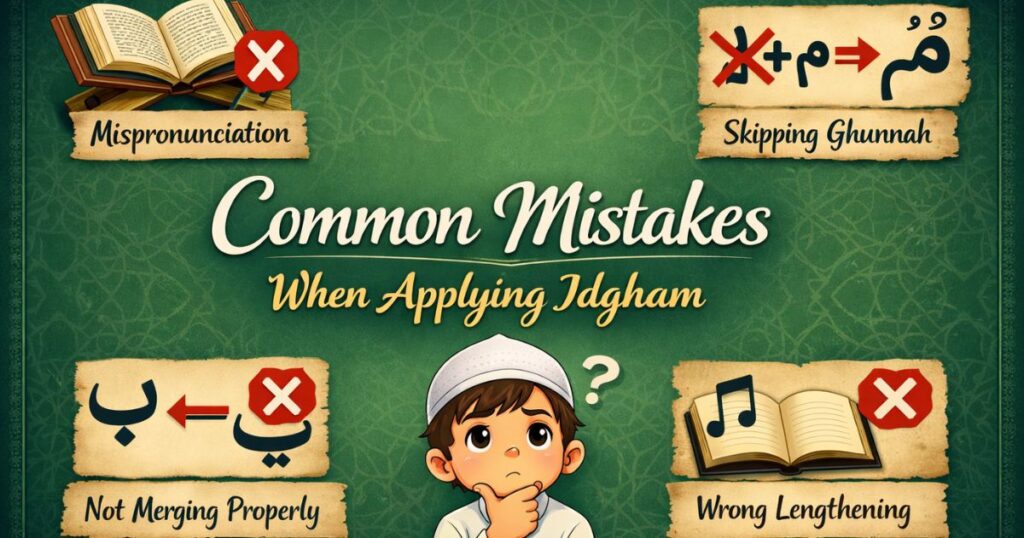
Even dedicated students make predictable idgham mistakes. Recognizing these errors early saves enormous frustration later. Most mistakes fall into three clear categories. Knowing them gives you a genuine head start.
The most damaging mistakes involve Ghunnah mismanagement. Students either rush it or skip it entirely. Both errors produce noticeably incorrect recitation sounds. Fix these first and everything else improves quickly.
Consistent self-recording exposes mistakes you’d otherwise miss completely. Listen back critically after every practice session. Compare your recitation honestly against expert reciters. That comparison reveals exactly where improvement is needed.
Overemphasizing Or Skipping Ghunnah
Rushing through Ghunnah is the single most common mistake. Students don’t hold the nasal hum long enough. The two-count duration gets compressed into almost nothing. The result sounds clipped and noticeably incorrect.
The opposite problem also exists over-holding the Ghunnah. Some students stretch it far beyond two counts. That creates an unnatural, exaggerated nasal sound. Balance is genuinely everything here.
For Idgham without Ghunnah, adding accidental nasalization is equally problematic. The merge must stay completely clean and silent. Any hint of humming signals a fundamental error. Train your ear to catch this immediately.
Merging Letters Incorrectly
Incomplete merging is surprisingly common among beginners. Students pronounce a faint ‘n’ before the following letter. For example they say “Min-waliyyin” instead of “Miw-waliyyin.” That leftover ‘n’ sound ruins the entire merge.
The fix requires mouth preparation before the merge happens. Shape your lips or tongue for the next letter early. Start the following letter’s sound simultaneously with the merge. Practice this transition slowly at first then gradually speed up.
Recording yourself exposes incomplete merges immediately and clearly. Play it back and listen specifically for residual ‘n’ sounds. They’re surprisingly easy to hear once you know what you’re listening for. Eliminate them one by one systematically.
Confusing Idgham With Other Tajweed Rules (Like Ikhfa Or Iqlab)
Four rules govern Noon Saakin and Tanween behavior. They’re Izhar, Idgham, Iqlab and Ikhfa. Beginners frequently mix them up especially Idgham and Ikhfa. The letters triggering each rule are completely different.
For instance Noon Saakin before ب triggers Iqlab not Idgham. The ‘n’ flips to an ‘m’ sound there. Applying idgham incorrectly in this situation creates real errors. Always identify the following letter precisely first.
A systematic learning approach prevents this confusion effectively. Study each rule separately before combining them together. Build a clear mental chart of which letters trigger which rules. Clarity here makes everything downstream significantly easier.
Tips For Mastering Idgham
Mastering idgham requires consistent and deliberate daily effort. There’s genuinely no shortcut worth taking here. However smart practice methods accelerate progress remarkably fast. These tips come from proven real-world teaching experience.
Passive listening builds powerful auditory memory over time. Active practice then converts that memory into muscle memory. Together they create a formidable and lasting foundation. Neither works nearly as well without the other.
Expert guidance remains the single most valuable resource available. A qualified teacher catches subtle errors that self-study misses entirely. Invest in proper instruction early and progress compounds beautifully. The difference in results is truly night and day.
Tips For Mastering Idgham
Listen First: Study expert reciters like Sheikh Al-Husary daily. Use Quran apps that highlight words during recitation. Train your ear before training your tongue. Auditory memory is genuinely your most powerful learning tool.
Record Yourself: Play back your recitation and compare it critically. You’ll catch errors invisible during live practice. This single habit accelerates improvement faster than almost anything else. Do it after every single practice session without exception.
Practice Systematically: Highlight every idgham instance on one Quran page. Recite that page repeatedly until the merges feel automatic. Then move to the next page confidently. Slow, deliberate progress beats rushed, sloppy practice every time.
What Are The 6 Letters Of Idgham?
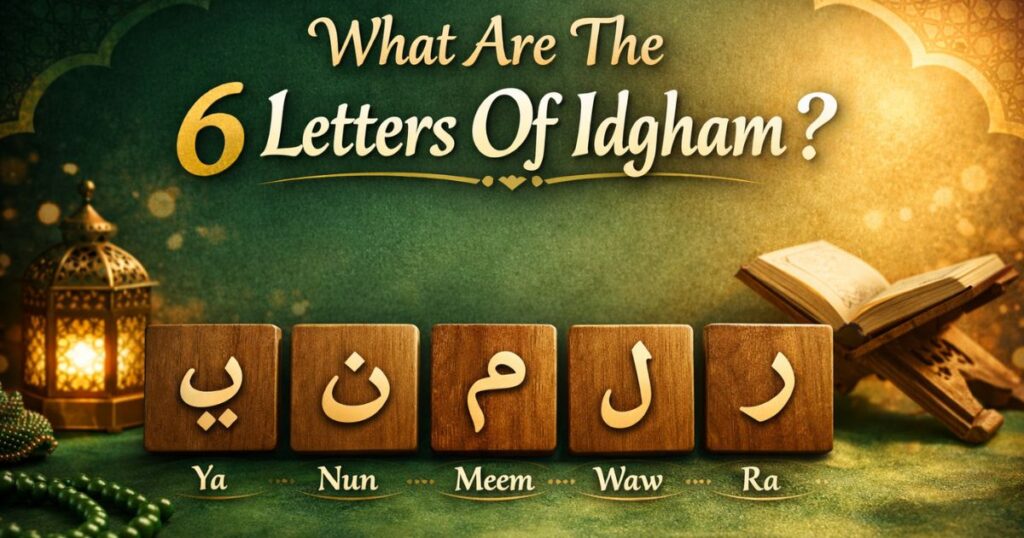
The six idgham letters live inside one memorable phrase يَرْمَلُون (Yarmaloon). Every serious Tajweed student memorizes this phrase early. It contains all six letters in sequence. That makes identification fast and completely reliable.
| Letter | Name | Group |
| ي | Ya | With Ghunnah |
| ن | Noon | With Ghunnah |
| م | Meem | With Ghunnah |
| و | Waw | With Ghunnah |
| ل | Lam | Without Ghunnah |
| ر | Ra | Without Ghunnah |
Memorize يَرْمَلُون and you’ve essentially memorized the entire idgham system. Four letters bring Ghunnah and two don’t. That simple division covers everything. It’s elegantly straightforward once it clicks.
The 7 Qirat In The Quran
The 7 Qirat are seven authentic Quranic recitation methods. Each carries a distinct name from a prominent early reciter. They differ in phonetics, grammar and specific pronunciation details. All seven are equally valid and divinely preserved.
| Qirat | Named After |
| 1 | Nafi’ Al-Madani |
| 2 | Ibn Kathir Al-Makki |
| 3 | Abu Amr Al-Basri |
| 4 | Ibn Amir Ash-Shami |
| 5 | Asim Al-Kufi |
| 6 | Hamzah Al-Kufi |
| 7 | Al-Kisa’i |
Today’s most widely used Qirat is Hafs an ‘Asim. Most Quran copies worldwide follow this specific method. Learning it gives you access to the globally recognized standard. It’s the natural and practical starting point for every student.
FAQ’S
What are idgham letters?
Idgham letters are six specific Arabic letters that cause the Noon Saakin sound to merge smoothly into them during Quran recitation.
How many idgham letters exist?
There are exactly six idgham letters collected in the phrase Yarmaloon. They split into two groups based on Ghunnah presence.
Which idgham letters produce Ghunnah?
Four idgham letters produce Ghunnah Ya, Noon, Meem and Waw. Scholars remember them through the simple phrase Yanmu meaning “it grows.”
Which idgham letters have no Ghunnah?
Two idgham letters carry no Ghunnah Lam and Ra. The merge happens instantly and cleanly with absolutely no nasal sound involved.
Why must students learn idgham letters?
Mastering idgham letters makes your recitation smooth and beautiful. Without them your Quran recitation sounds choppy, disconnected and technically incorrect.
Conclusion
Understanding “What Is Idgham in Tajweed” changes everything about your recitation. Idgham letters aren’t just rules they’re the heartbeat of beautiful Quran recitation. There are six idgham letters total. Master them and your recitation flows effortlessly.
Idgham letters split into two simple groups. Four letters carry Ghunnah and two don’t. That’s genuinely all you need to remember. Start practicing idgham letters today. Listen to expert reciters daily. Record yourself consistently. Every small effort compounds into something truly breathtaking. Your Quran recitation deserves that level of dedication and care.